
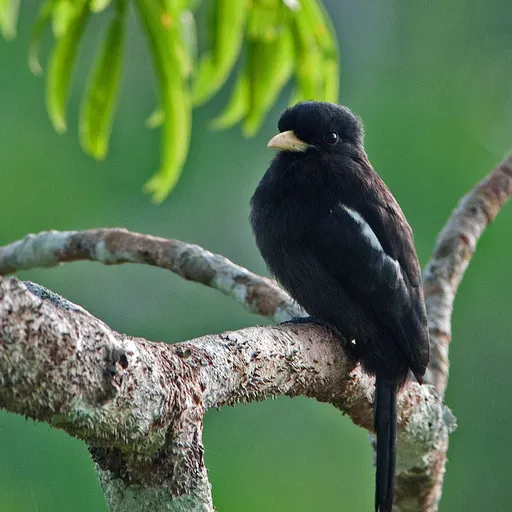
Yellow-billed Nunbird
Monasa flavirostris
Least Concern
Overview
The yellow-billed nunbird (Monasa flavirostris) is a near-passerine bird belonging to the family Bucconidae. It is classified as Least Concern on the IUCN Red List and is found across parts of the upper Amazon Basin.
Identification
- Size 23 to 25 cm in length with a mass of approximately 39 g.
- Plumage is mostly sooty black, with a very dark gray belly and greenish-black tail.
- Features white lesser wing coverts that appear as spots on the closed wing, contrasting with a shorter yellow bill.
- Dark eyes and blackish feet; immatures appear slightly duller with less prominent white markings.
Habitat
Inhabits somewhat open landscapes such as transitional forest, secondary forest, terra firme edges, and regenerating clearings with scattered trees, ranging from the understory to the subcanopy. Its range covers two areas of the upper Amazon Basin: one from southeastern Colombia through eastern Ecuador to northern Peru, and another spanning eastern Peru, northern Bolivia, and western Brazil up to the upper Purus River.
Diet
The species forages by making sallies from a high exposed perch to catch prey in the air. Its diet is assumed to consist mostly of insects, similar to other nunbirds, though this aspect of its behaviour has not been extensively studied.
Did you know?
The bird is considered rare within its range but may be undercounted due to its unobtrusive habits.
Sources
- Wikipedia · CC BY-SA 4.0
- Wikidata · CC0 1.0