
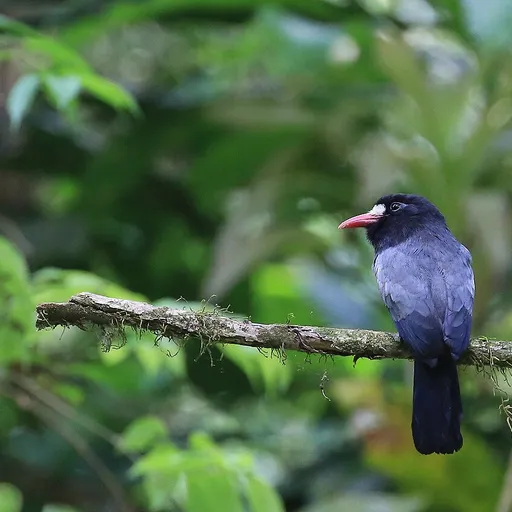
White-fronted Nunbird
Monasa morphoeus
Least Concern
Overview
The white-fronted nunbird (Monasa morphoeus) is a species of near-passerine bird belonging to the family Bucconidae. It is classified as a species of Least Concern on the IUCN Red List, possessing a vast range and a large population of at least five million mature individuals.
Identification
- Adults are predominantly dark greyish-black with white foreheads and chins, though immatures feature a buffy-rufous face.
- The bill is orange-red, the eyes are brown, and the legs are black.
- Size ranges from 21 to 29 cm, with weight varying by region from 63 to 101 g.
- Vocalisations include a blurred descending whistle ending in a rippling trill, loud mournful 'how how how' calls, and group choruses of gobbling and barking notes.
Habitat
Found across Central and South America, including Bolivia, Brazil, Colombia, Costa Rica, Ecuador, Honduras, Nicaragua, Panama, Peru, and Venezuela. It inhabits diverse wooded landscapes such as lowland terra firme, rainforest, gallery forest, and transitional forest, while also utilising open environments like partly deforested areas, shaded cacao plantations, and abandoned clearings. The species typically occurs below 300 m, though it reaches higher altitudes of up to 1,350 m in Ecuador.
Diet
The diet consists mainly of insects, supplemented by other arthropods, small lizards, amphibians, and some fruits. It forages by following troops of primates, army ant swarms, and flocks of caciques and oropendolas to capture prey dislodged by their activities.
Did you know?
Breeding involves up to six adults jointly attending a clutch of two or three eggs and the young within a leaf-lined chamber at the end of a tunnel excavated in level or sloping ground.
Sources
- Wikipedia · CC BY-SA 4.0
- Wikidata · CC0 1.0