
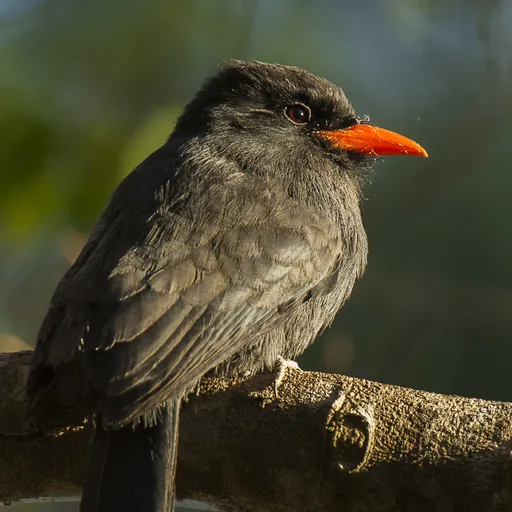
Black-fronted Nunbird
Monasa nigrifrons
Least Concern
Overview
The black-fronted nunbird (Monasa nigrifrons) is a species of near-passerine bird in the family Bucconidae. It is distributed across parts of South America, including Bolivia, Brazil, Colombia, Ecuador, and Peru.
Identification
- Adults of the nominate subspecies are mostly sooty black, darkest around the bill, with a blue-grey rear and blue-black tail.
- Measures 26 to 29 cm (10 to 11 in) in length and weighs 68 to 98 g (2.4 to 3.5 oz).
- Possesses a red bill, dark eyes, and black legs.
- Song is described as a rapid series of melodious upslurred 'clerry' or 'curry' whistles, occasionally broken by downslurred 'turra turra' trills.
Habitat
Found in the Amazon Basin, specifically in southeastern Colombia, eastern Ecuador, eastern Peru, much of Brazil, and eastern Bolivia. The species inhabits trees and bamboo along river and lake margins, favouring várzea, igapó, and gallery forests, as well as secondary and floodplain forests. It avoids terra firme forest and is found at elevations from sea level up to 1,000 m (3,300 ft).
Diet
Primarily feeds on insects, other arthropods, small lizards, and amphibians. It takes most prey in flight but also picks from the ground and foliage up to 6 m (20 ft) high. It frequently follows troops of primates and army ant swarms to capture dislodged prey and may join mixed-species foraging flocks.
Did you know?
Unlike many other nunbirds, this species actively shuns terra firme forest.
Sources
- Wikipedia · CC BY-SA 4.0
- Wikidata · CC0 1.0