
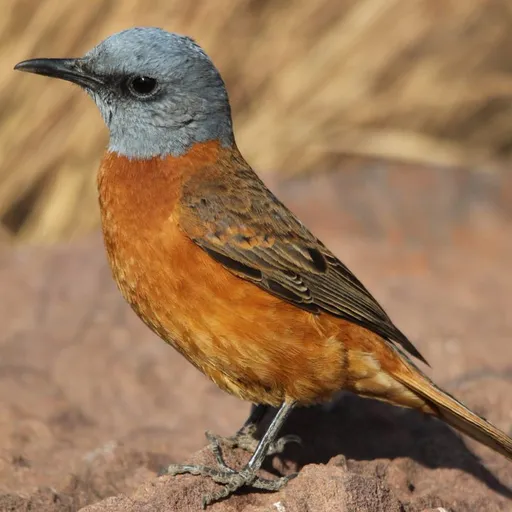
Cape Rock Thrush
Monticola rupestris
Least Concern
Overview
The Cape Rock-Thrush (Monticola rupestris) is a large, stocky bird within the family Muscicapidae. It is a common, non-migratory endemic resident of eastern and southern South Africa, Lesotho, and Eswatini, though it undertakes seasonal altitudinal movements.
Identification
- Large and stocky body measuring 21-22 cm in length.
- Adult males feature a blue-grey head, orange underparts and outer tail feathers, with brown wings and back; females have brown heads and richer orange underparts.
- Distinctive whistled song includes sequences such as “tsee-tsee-tseet-chee-chweeeoo” and high-pitched whistles and trills like “wiit liio-o pii’p sii piiu chiwii trrr.”
Habitat
This species inhabits mountainous rocky environments with scattered vegetation, typically on slopes between 1,200 and 3,000 meters in elevation. Key regions include the Drakensberg Mountains and highlands of Lesotho and Eswatini, where it is generally sedentary except for winter shifts to lower elevations.
Diet
The bird consumes a diverse diet of invertebrates such as spiders, millipedes, and mollusks, as well as small vertebrates like frogs, supplementing this with fruits, seeds, and nectar when insects are scarce. Foraging occurs on the ground and among rocks using a combination of hopping and scanning.
Did you know?
The male is known to mimic other bird species and performs courtship displays that include singing from elevated perches, wing flicking, and occasionally offering food to the female.
Sources
- Wikipedia · CC BY-SA 4.0
- Wikidata · CC0 1.0