
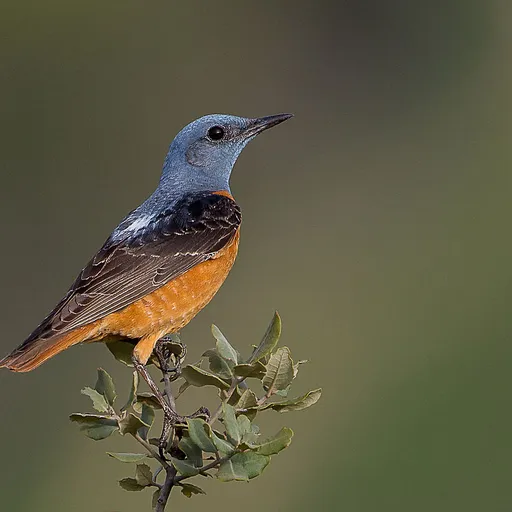
Common Rock Thrush
Monticola saxatilis
Least Concern
Listen
XC917397 · Thomas SIGNEAU · Arrondissement de Florac (near Gatuzières), Lozère, Occitanie, France · CC BY-SA 4.0
Overview
The common rock thrush, also known as the rufous-tailed rock thrush, is a species of chat that is strongly migratory and classified as Least Concern. It breeds in southern Europe and Central Asia, with all populations wintering in Africa south of the Sahara.
Identification
- Medium-sized but stocky thrush measuring 17–20 cm in length.
- Summer males have a blue-grey head, orange underparts and outer tail feathers, dark brown wings, and a white back.
- Females and immatures possess dark brown scaly upperparts and paler brown scaly underparts, with reddish outer tail feathers similar to the male.
- Males produce a clear and tuneful song.
Habitat
This species breeds in open dry hilly areas, usually above 1500 m, and nests in rock cavities. Its range spans from southern Europe across Central Asia to northern China, though it has contracted somewhat at the periphery due to habitat destruction.
Diet
The common rock thrush is omnivorous, feeding on a wide range of insects, berries, and small reptiles.
Did you know?
The scientific name Monticola saxatilis is derived from Latin roots meaning 'mountain-dwelling' and 'rock-frequenting', referencing its preference for stony environments. The species was first described by Carl Linnaeus in 1766, citing an earlier description by the French zoologist Mathurin Jacques Brisson.
Sources
- Wikipedia · CC BY-SA 4.0
- Wikidata · CC0 1.0