
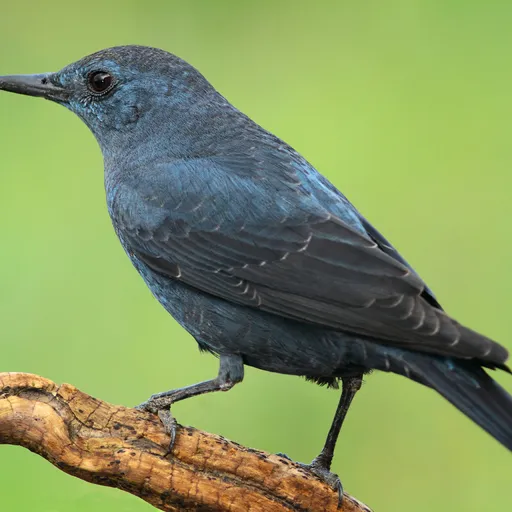
Blue Rock Thrush
Monticola solitarius
Least Concern
Overview
The blue rock thrush (Monticola solitarius) is a thrush-like Old World flycatcher that was formerly placed in the family Turdidae. It is a starling-sized bird that is the official national bird of Malta.
Identification
- Starling-sized, measuring 21–23 cm in length with a long, slim bill.
- Breeding males of the nominate subspecies have all blue-grey plumage, apart from darker wings.
- Females and immatures possess dark brown upperparts and paler brown scaly underparts.
- The male of the subspecies M. s. philippensis displays rufous-chestnut plumage from the mid-breast to the undertail.
- The male sings a clear, melodious call that is similar to but louder than that of the rock thrush.
Habitat
The species breeds in southern Europe, northwest Africa, and from Central Asia to northern China and Malaysia. It inhabits open mountainous areas, with a strong preference for rocky cliffs, exposed rock faces, escarpments, and coastal outcrops. Some populations are resident with altitudinal movements, while others migrate to sub-Saharan Africa, India, and southeast Asia for the winter.
Diet
As an omnivore, the blue rock thrush consumes a wide variety of insects and small reptiles. It also feeds on berries and seeds.
Did you know?
The blue rock thrush has been spotted in North America only three times: in British Columbia in 1997, in Oregon and the Farallon Islands in 2024, and in Portland in September 2026. Its typical wild lifespan is 5–10 years, making it highly unlikely that the 1997 sighting was the same individual as the 2024 one.
Sources
- Wikipedia · CC BY-SA 4.0
- Wikidata · CC0 1.0