
Barred Hawk
Morphnarchus princeps
Least Concern
Overview
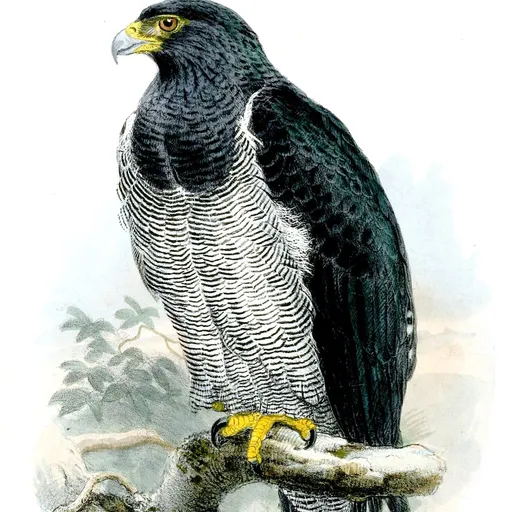
The barred hawk, Morphnarchus princeps, is a species of bird of prey in the family Accipitridae, also known as the black-chested hawk. It is a fairly large hawk, similar in size to a large member of the Buteo genus, that mainly lives in the dense forests of lowland and mountainous areas across Central and South America.
Identification
- Appears black with a single white tail bar from above, with a dark grey body and a white chest featuring uniformly spaced black bars.
- Total length ranges from 51 to 61 cm with a wingspan of 112 to 124 cm, and it weighs about 1 kg.
- Possesses a snout-like bill that gives the appearance of a heavy head.
- Calls include high-pitched screaming or whistling, hoarse "whees", "yips", "dits", and "weeps", and the bird is usually noisy when soaring.
Habitat
Found in Colombia, Costa Rica, Ecuador, Panama, and Peru, this species primarily inhabits subtropical or tropical moist lowland and montane forests. It lives between 300 and 2,500 m in elevation, being most abundant between 900 and 1,600 m, and is classified as Least Concern on the IUCN Red List.
Diet
Barred hawks forage in the canopy and along mountain forests, using both active soaring and silent perching to hunt for slow prey such as frogs, snakes, small mammals, birds, and large insects. A significant portion of their diet consists of caecilians, which are subterranean, worm-like amphibians that may be drawn to the surface by recent rainfall.
Did you know?
Recent research using mtDNA has revealed that the black and white plumage of the genus Leucopternis has evolved at least twice, suggesting that the widespread occurrence of this pattern is the result of plumage convergence in forested habitats.
Sources
- Wikipedia · CC BY-SA 4.0
- Wikidata · CC0 1.0