
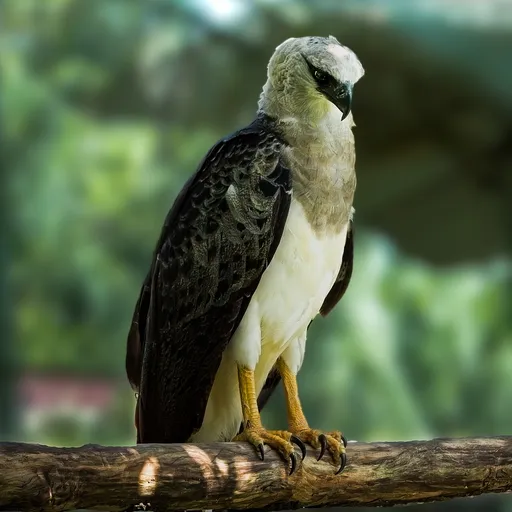
Crested Eagle
Morphnus guianensis
Near Threatened
Overview
The crested eagle (Morphnus guianensis) is a large neotropical eagle and the sole member of the genus Morphnus. It is a powerful predator that ranges extensively throughout Central and South America, primarily favouring tropical lowland forests.
Identification
- Large but slender body measuring 71 to 89 cm in length with a wingspan of 138 to 176 cm.
- Plumage varies from light brownish-gray to sooty gray or blackish, featuring a white throat and a small dark mask across the eyes.
- Possesses a large head with an extended feather crest and bare legs with a long tarsus.
- Juveniles have a white head and chest with marbled-gray wings, transitioning to sandy-gray by the second year.
Habitat
Inhabits humid lowland forests, predominantly old-growth tropical rainforests, as well as gallery strips and forest ravines. The species typically occurs from sea level up to 600 m, though it reaches elevations of 1,000 to 1,600 m in the Andes. It shows a predilection for being near water, including coasts or rivers.
Diet
Functions as a still-hunter, perching for long periods to visually scan the forest. Primarily preys on small to mid-sized mammals, especially monkeys, arboreal rodents, opossums, and sloths, as well as snakes, lizards, and birds. Hunting behaviour often targets nocturnal prey, and individuals may attack young harpy eagles or even inspect their nests.
Did you know?
In an unusual interspecific interaction observed in Panama, an adult crested eagle was seen feeding a juvenile harpy eagle while the harpy parents were away, bringing both food and nesting material to the nest.
Sources
- Wikipedia · CC BY-SA 4.0
- Wikidata · CC0 1.0