
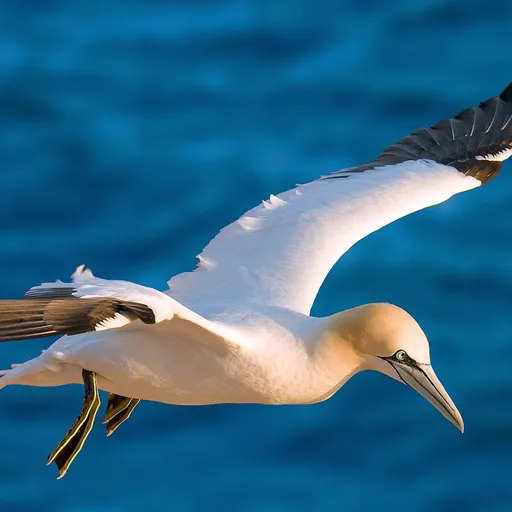
Northern Gannet
Morus bassanus
Least Concern
Listen
XC1143445 · Sonothèque ADVL · Camlez, Cotes-d'Armor, Brittany, France · CC0 1.0
Overview
The northern gannet (Morus bassanus) is a seabird and the largest species in the gannet family, Sulidae. Native to the coasts of the North Atlantic, it is the largest seabird found in the northern Atlantic region.
Identification
- Mainly white streamlined body with a long neck and long, slender wings; wings are edged with dark brown-black feathers.
- Head and nape possess a buff tinge that is more prominent in the breeding season, with a long, pointed blue-grey bill contrasting against black, bare skin around the mouth and eyes.
- Adults measure 87–100 cm in length with a wingspan of 170–180 cm; juveniles are mostly grey-brown and take five years to reach full white maturity.
- Vocalisations include a harsh arrah-arrah call when arriving at or challenging at the colony, shortened to rah rah while fishing, and lengthened to ooo-ah when taking off.
Habitat
Breeding colonies are located on both sides of the North Atlantic, specifically on offshore islands with cliffs such as Bass Rock in Scotland and Bonaventure Island off Quebec. The range extends northward and eastward, with recent colonies established on Russia's Kola Peninsula and Bear Island in Svalbard.
Diet
Fish constitute the mainstay of the northern gannet's diet. It forages by making high-speed dives into the sea at speeds of up to 60 mph to capture prey.
Did you know?
The bird's genus name, Morus, derives from the Ancient Greek word for 'foolish', referring to the lack of fear shown by breeding gannets which enables them to be easily killed.
Sources
- Wikipedia · CC BY-SA 4.0
- Wikidata · CC0 1.0