
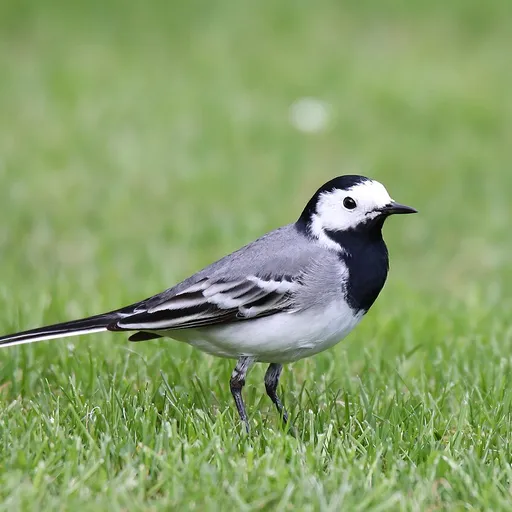
White Wagtail
Motacilla alba
Least Concern
Listen
XC1041131 · Sonothèque ADVL · Roz-sur-Couesnon, Ille-et-Vilaine, Brittany, France · CC0 1.0
Overview
The white wagtail (Motacilla alba) is a small passerine bird in the family Motacillidae, characterised by its slender build and constantly wagging tail. It breeds across much of Europe and Asia, with populations in milder regions remaining resident while northern birds migrate to Africa. There are between nine and eleven subspecies, including the black-backed pied wagtail found in Ireland and Great Britain.
Identification
- Slender body measuring 16.5 to 19 cm in length, with East Asian subspecies reaching up to 21 cm.
- Distinctive long tail that is wagged constantly, a trait that gives the species its common name.
- Plumage varies by subspecies; the pied wagtail (M. a. yarrellii) features a black back in males and dark grey in females, replacing the pale grey of the nominate race.
- Call is a sharp chissick, which is slightly softer than the call of the pied wagtail.
Habitat
This species breeds throughout Eurasia up to latitudes 75°N, as well as in the mountains of Morocco and western Alaska, but is absent from deserts. It prefers open country, often near habitation and water, and has adapted to urban areas by foraging on paved surfaces like car parks. Nests are typically placed in crevices of stone walls, banks, bridges, and even human-made structures such as buildings.
Diet
The white wagtail is insectivorous, feeding primarily on terrestrial and aquatic insects and small invertebrates such as beetles, dragonflies, spiders, and flies. It forages in bare areas where it can easily see and pursue prey, showing unusual adaptability by continuing to feed on insects during winter in non-migratory regions. Small fish fry have also been recorded as part of its diet.
Did you know?
White wagtails are known to nest in association with other animals, including inside the nests of golden eagles and near beaver dams. In one remarkable instance, a nest was discovered inside the skull of a walrus.
Sources
- Wikipedia · CC BY-SA 4.0
- Wikidata · CC0 1.0