
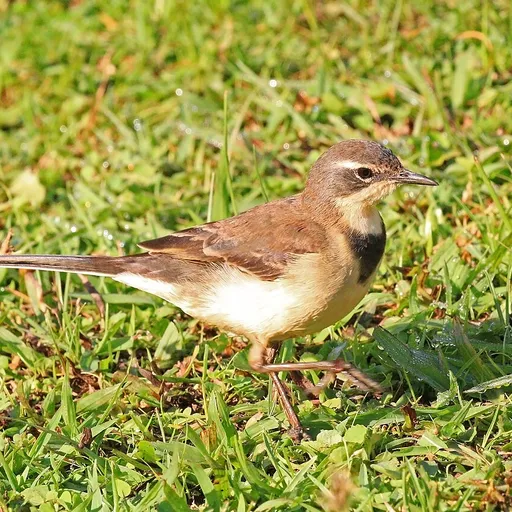
Cape Wagtail
Motacilla capensis
Least Concern
Overview
The Cape wagtail, also known as Wells's wagtail, is a small insectivorous passerine bird widespread in southern Africa. It is a mostly resident and territorial species that frequents water's edge, lawns, and gardens, though it may undertake limited altitudinal migration or form flocks outside the breeding season.
Identification
- Dull plumage with olive grey breast and face, featuring a tan supercilium and dark lores.
- Creamy white underparts that may show a faint pinkish wash on the lower breast and belly.
- An iconic black triangle on the chest and a dusky breast band.
- Brownish black wings with pale feather edges, and a blackish tail with the two outer tail feathers being white.
Habitat
Found in eastern and southern Africa from Uganda and Kenya south to the Western Cape, the Cape of Good Hope, and western Africa. It inhabits almost any area with open ground adjacent to water, as well as rocky coastlines, farms, villages, cultivated land, parks, gardens, and urban centres. In east Africa, it is generally found above 2,000 m in altitude.
Diet
The main food is invertebrates, foraged mainly on the ground or in shallow water, though carrion is also consumed. It has been observed eating insects attracted by lights or caught in car radiators, as well as fiddler crabs, sandhoppers, snails, ticks, tadpoles, small fish, small chameleons, and human food.
Did you know?
Males will fiercely attack their own reflection when seen in mirrors or windows. The nest, built by both sexes, consists of a cup made from a wide range of natural and artificial materials, such as wool and feathers, situated in recesses or man-made locations like holes in walls or bridge structures.
Sources
- Wikipedia · CC BY-SA 4.0
- Wikidata · CC0 1.0