
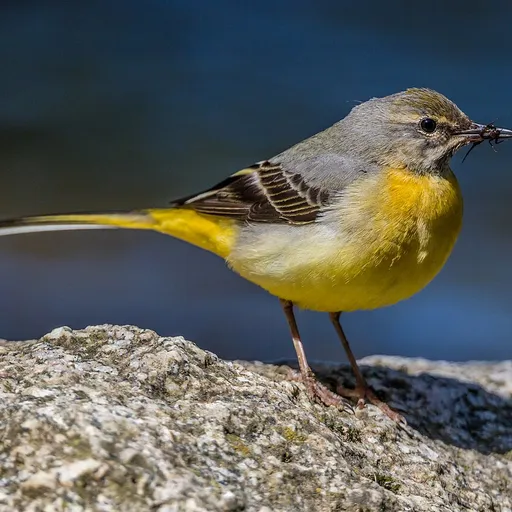
Grey Wagtail
Motacilla cinerea
Least Concern
Listen
XC1007991 · Lionel TRIBOULIN · Ponte dos Sete Arcos (near Nordeste), Nordeste, Açores, Portugal · CC0 1.0
Overview
The grey wagtail (Motacilla cinerea) is a slim member of the wagtail family, measuring around 18–19 cm in length. It is widely distributed across the Palearctic region, with populations breeding in Eurosiberia and migrating to tropical areas in Asia and Africa.
Identification
- Upperparts are grey with a narrow white supercilium and a broken eye ring.
- Whitish underparts contrast with a yellow vent, while breeding males possess a black throat edged by whitish moustachial stripes.
- The bird has a clear, sharp call note and a song consisting of trills.
Habitat
The species is always associated with running water during the breeding season, nesting on embankments between stones and roots, though man-made structures near streams are also used. Outside the breeding season, they may be found around lakes, coasts, and other watery habitats. Its range extends from Western Europe and the British Isles to central and northeast Asia, with wintering grounds in Africa and Asia.
Diet
Grey wagtails feed on a variety of aquatic invertebrates, including adult flies, mayflies, beetles, crustaceans, and molluscs. They forage singly or in pairs on meadows or shallow water marshes, and in winter often forage along roadsides, flushing with a sharp call and flying up further along the road before turning back.
Did you know?
Adults often carry parasitic ticks, specifically Ixodes ricinus, which can harbour Borrelia and potentially disperse Lyme disease over wide regions. Additionally, there are records of adult grey wagtails engaging in interspecific feeding of chicks from the white-throated dipper, a species that shares their habitat in some parts of its range.
Sources
- Wikipedia · CC BY-SA 4.0
- Wikidata · CC0 1.0