
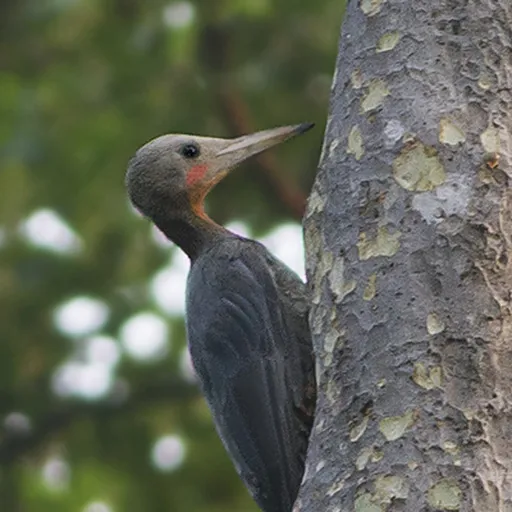
Great Slaty Woodpecker
Mulleripicus pulverulentus
Vulnerable
Overview
The great slaty woodpecker, Mulleripicus pulverulentus, is a species of bird in the family Picidae found across the Indian subcontinent and Southeast Asia. As the largest confirmed living woodpecker, it is a unique and basically unmistakable bird classified as Vulnerable on the IUCN Red List.
Identification
- Size: 45–55 cm (18–22 in) in length with a weight of 360–563 g, making it the largest woodpecker in the world.
- Plumage: Almost entirely dark grey or blackish slate-grey with small white spots on the head and neck; males possess small red moustaches.
- Structure: Features a very long, strong chisel-tipped bill, an elongated neck, and a long tail, sometimes showing a slight crest.
- Call: A weak, quiet whinnying cackle of 2 to 5 notes, usually four, described as 'woikwoikwoikwoik' with the initial note higher in pitch and the middle note distinctly lower.
Habitat
This species prefers primary semi-open, moist deciduous, and tropical evergreen forests, though it may occasionally use secondary forests and clearings with scattered tall trees. It favours sprawling stands of dipterocarp and teak trees, as well as mature sal forests, swamp forests, and mangroves with tall, mature trees, usually occurring below 600 m but locally up to 2,000 m. Its range includes Bangladesh, Bhutan, Brunei, Cambodia, India, Indonesia, Laos, Malaysia, Myanmar, Nepal, the Philippines, Singapore, Thailand, and Vietnam, but it does not inhabit Bali.
Diet
Groups of 3 to 6 individuals forage on shared feeding sites such as nests of social insects, particularly ants, as well as larvae of wood-boring beetles, termites, and stingless bees, with occasional small fruit. Females generally search for sources while males use their slightly larger bills to open them, primarily targeting large branches or trunks of living trees. Foraging methods include gleaning, probing, pecking, prising off bark, and hammering with powerful blows, with gleaning being the most important method.
Did you know?
Despite its massive size, the great slaty woodpecker has a remarkably weak and quiet voice, especially compared to other large woodpeckers which tend to have loud, booming voices. Its flight is described as 'crow-like' and its feather rustle noisily as it travels long distances over the treetops.
Sources
- Wikipedia · CC BY-SA 4.0
- Wikidata · CC0 1.0