
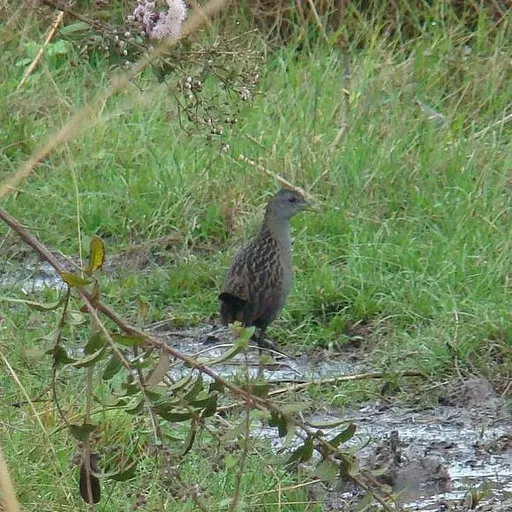
Ash-throated Crake
Mustelirallus albicollis
Listen
XC757634 · Belén y Diego · Pancho Cue, General Alvear, Corrientes, Argentina · CC0 1.0
Overview
The ash-throated crake (Mustelirallus albicollis) is a species of bird in the rail, crake, and coot family Rallidae. It is found in every mainland South American country except Chile and is described as solitary, shy, and difficult to observe.
Identification
- Size: 21 to 24 cm (8.3 to 9.4 in) long and weighing 90 to 120 g (3.2 to 4.2 oz).
- Plumage: Adults of the nominate subspecies have black upperparts with brown edges to the feathers, a pale gray throat, breast, and belly, and black and white bars on the flanks and undertail coverts.
- Features: A short greenish bill and purplish brown legs.
- Vocalisation: A repeated, loud, fast series of vibrating notes sounding like machine-gun 'd'd'd'd'd'-ou', and a sharp 'tuk' call.
Habitat
The species inhabits a wide variety of damp to wet landscapes including freshwater marshes, moriche swamps, rice fields, savanna, and pastures, though it tends to be in the drier parts of marshes and swamps. In elevation it ranges from sea level to 1,200 m (3,900 ft). Subspecies have completely separate ranges, with M. a. typhoeca in the north and M. a. albicollis in the east and south.
Diet
The ash-throated crake usually forages out of sight in vegetation but sometimes emerges to the edges of it. Its diet consists of grass seeds and adults and larvae of insects such as Lepidoptera, Formicidae, and Coleoptera.
Did you know?
The nest is a large open bowl made out of dry grass, often hidden between tree roots or grass, with a clutch of two to three eggs that can be as many as six, though little is known about its breeding biology.