
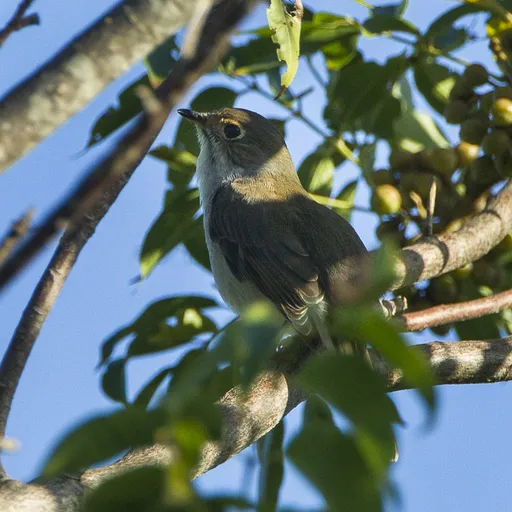
Cuban Solitaire
Myadestes elisabeth
Least Concern
Overview
The Cuban solitaire, also known as the Cuban nightingale, is a bird species in the thrush family Turdidae. It is endemic to Cuba and is considered a sedentary year-round resident.
Identification
- Measures 19 to 20.5 cm in length with a weight of 21.5 to 33 g; sexes have identical plumage.
- Olive brown upperparts and head, with dull whitish lores, a thin whitish eye-ring, and a dark brown malar line dividing the whitish lower face.
- Dull whitish underparts that are slightly grayer on the breast; blackish maxilla and dusky-tipped horn-colored mandible.
- Song is described as high-pitched, flute-like, and melodious, likened to the sound of rubbing a wet finger on glass.
Habitat
The species has a disjunct distribution on the island of Cuba, with populations in the far western Pinar del Río and Artemisa provinces and the former Oriente Province in the east. It inhabits pine, semi-deciduous, and evergreen forest in hilly and mountainous terrain, reaching elevations of up to 2,000 m.
Diet
The Cuban solitaire feeds on insects and fruit, including ripe pine nuts. It forages primarily in the forest canopy, though it may feed near the ground on slopes, making sallies from perches to catch insects in mid-air or from vegetation.
Did you know?
The bird's song is often compared to the sound of rubbing a wet finger on the rim of a glass. It previously had a second subspecies, M. e. retrusus, which went extinct in the 1930s.
Sources
- Wikipedia · CC BY-SA 4.0
- Wikidata · CC0 1.0