
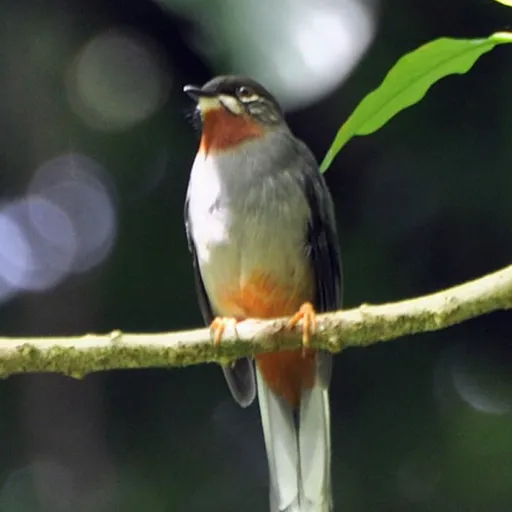
Rufous-throated Solitaire
Myadestes genibarbis
Least Concern
Listen
XC451045 · Justin Watts · Des Cartier Trail, St Lucia · CC BY-SA 4.0
Overview
The rufous-throated solitaire, Myadestes genibarbis, is a species of thrush found across several Caribbean islands. It is a year-round resident that has been assessed as Least Concern by the IUCN, although its population is believed to be decreasing in some areas.
Identification
- Adults of the nominate subspecies feature a slate-gray crown, a white crescent below the eye, and a dark malar stripe on an orange-flecked face.
- The throat is distinctively chestnut, contrasting with a medium gray breast and ochraceous-tawny belly and vent.
- The bird measures 19 to 20.5 cm in length and possesses a black bill with yellowish legs and feet.
- It sings a haunting, minor-key whistle at dawn, characterised by a sequence of low, high, and low notes interspersed with a ringing double note.
Habitat
This species primarily inhabits dense, moist, lowland and montane evergreen forests in the tropical zone, ranging from sea level to 1,800 m. It is also found in groves along streams that traverse meadows. Its range includes Jamaica, Hispaniola, and the Lesser Antilles islands of Dominica, Martinique, St. Lucia, and St. Vincent.
Diet
The rufous-throated solitaire feeds on both fruit and insects. It forages mostly in trees and low vegetation, plucking fruit with aerial sallies from a perch. Insects are captured by sallying from vegetation, taking them in mid-air, or pouncing from a perch onto the ground.
Did you know?
In Dominica, the bird is known as the siffleur montagne, or mountain whistler, a name that inspired the early 1970s folk group, the Siffleur Montagne Chorale. In Haiti, it is referred to as 'Mizisyen', a name that evokes a sense of musicality.
Sources
- Wikipedia · CC BY-SA 4.0
- Wikidata · CC0 1.0