
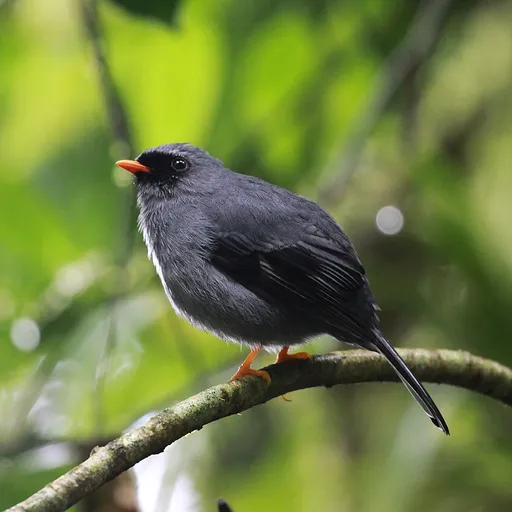
Black-faced Solitaire
Myadestes melanops
Least Concern
Overview
The black-faced solitaire (Myadestes melanops) is a bird in the thrush family endemic to the highlands of Costa Rica and western Panama. It remains common in protected and inaccessible areas, although trapping for the cage-bird trade has negatively impacted its numbers in other locations.
Identification
- A slim thrush measuring 16–18.5 cm (6.3–7.3 in) in length with an average weight of 33 g (1.2 oz).
- Adult plumage is slate gray with a contrasting black face and chin, a broad orange bill, and orange legs.
- Wings and tail are slate-edged black, while silvery-white underwing coverts are prominent in flight.
- Juveniles display buff streaks on the head and upper parts, with buff and brown mottling on the underparts.
- The song is a beautiful, slow, fluty whistle given mainly in the evening; the call is described as a nasal ghank or liquid quirt.
Habitat
This species inhabits dense undergrowth and bamboo clumps within wet mountain forests, typically at altitudes ranging from 750 to 3,000 m (2,460 to 9,840 ft). During the wet season, it disperses as low as 400 m (1,300 ft), where it may form loose flocks. The range is limited to the highlands of Costa Rica and western Panama.
Diet
The black-faced solitaire primarily forages low in vegetation for berries, although it also consumes insects. To locate food, it may ascend into the canopy or emerge into trees situated in pastures.
Did you know?
Although the bird's song is considered wonderfully pure and ethereal in nature, its sound is so distinct that it is commonly referred to as the 'squeaky hinge bird' when held in a cage.
Sources
- Wikipedia · CC BY-SA 4.0
- Wikidata · CC0 1.0