
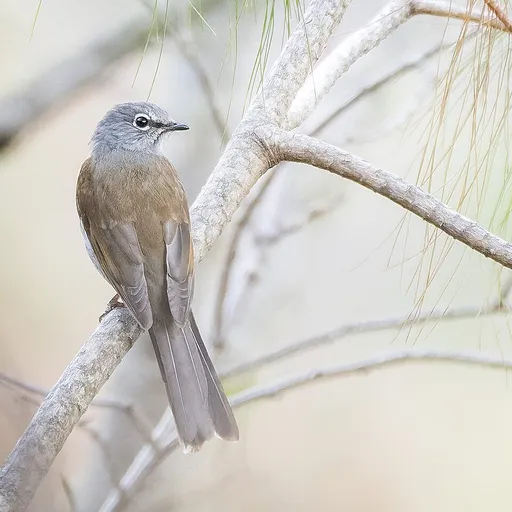
Brown-backed Solitaire
Myadestes occidentalis
Least Concern
Overview
The brown-backed solitaire (Myadestes occidentalis) is a thrush native to montane pine-oak woodlands stretching from Mexico to Honduras. It is classified as Least Concern by the IUCN, with an estimated population of at least 500,000 mature individuals.
Identification
- Length of 20.5 to 21.5 cm with a dull darkish grey head featuring black cheeks, a white chin, and a white 'moustache' stripe.
- Upper back is dull darkish grey transitioning to olive-rufous on the rump and tail, with outer tail feathers tipped in white.
- Breast is dull darkish grey fading to paler grey on the belly, with scapulars and wing feather edges in a richer rusty brown.
- Song is described as highly ventriloquial, starting with a slowly descending sweet whistle that accelerates into a squeaky, metallic jangling crescendo.
Habitat
Found in a variety of forest types in the subtropical zone, including cloud forest, pine-oak, montane evergreen, lowland evergreen, and semi-deciduous forests. Elevation ranges from approximately 300 to 3,500 m in the northern part of its range, but south of Mexico it is usually found above 1,450 m.
Diet
Feeds primarily on fruits, with a preference for those of Bumelia and Prunus species. Foraging behaviour varies by source, occurring in clearings and up to the middle strata, or from the mid- to upper levels of the forest.
Did you know?
The species is a common cage bird in Mexico, a fact that has caused previous reports of the bird in the United States to be rejected due to concerns that the birds were escaped from captivity.
Sources
- Wikipedia · CC BY-SA 4.0
- Wikidata · CC0 1.0