
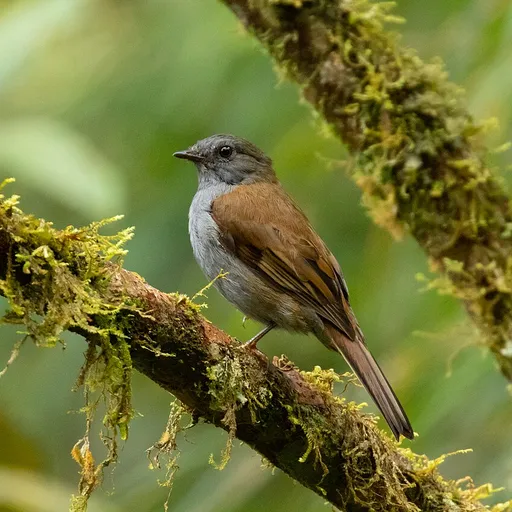
Andean Solitaire
Myadestes ralloides
Least Concern
Listen
XC855489 · Rosa Elena Albornoz · San Antonio De Los Altos (near Parroquia Macarao), Municipio Los Salias, Miranda, Venezuela · CC0 1.0
Overview
The Andean solitaire (Myadestes ralloides) is a species of bird in the family Turdidae, commonly known as the thrushes. It is found across the Andes in Bolivia, Colombia, Ecuador, Peru, and Venezuela, where it is assessed as being of Least Concern by the IUCN.
Identification
- Length of 17 to 18 cm with a weight of 25.5 to 37 g, featuring dull grayish olive crowns and dull medium gray faces in the nominate subspecies.
- Reddish brown backs, rumps, and wings, with underparts that are dull medium gray and a dusky bill.
- Pale brown legs, though some subspecies display yellowish legs and richer brown upperparts.
- Distinctive songs that vary by subspecies, ranging from loud, lilting series of flute-like liquid notes to rusty, squeaky whistled phrases.
Habitat
The Andean solitaire inhabits humid forest in the foothills and mountains, as well as mature secondary forest, favouring ravines and mountain streams. It has a disjunct distribution throughout the Andes, generally ranging in elevation between 900 and 2,800 m, though it can occur as high as 4,500 m in Venezuela and as low as 600 m in Peru.
Diet
It feeds on insects and fruit, foraging mostly in the lower to mid-levels of the forest. It plucks fruit while perched or makes aerial sallies from a perch, and catches insects by plucking them from vegetation with a sally into mid-air. It attends army ant swarms but remains in the undergrowth rather than on the ground.
Did you know?
Although it does not follow mixed-species feeding flocks, it will share fruiting trees with other species and attends army ant swarms, yet it prefers to stay in the undergrowth rather than foraging on the ground.
Sources
- Wikipedia · CC BY-SA 4.0
- Wikidata · CC0 1.0