
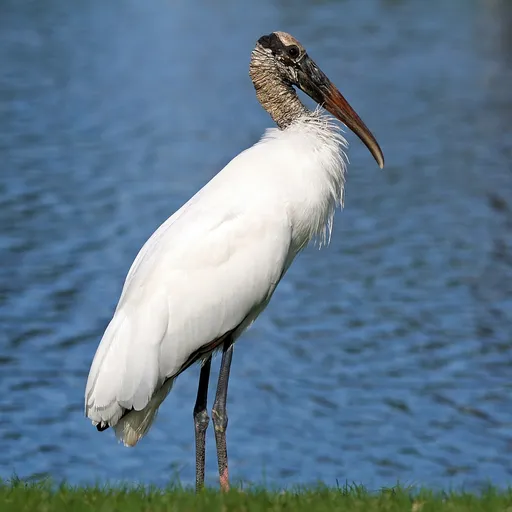
Wood Stork
Mycteria americana
Least Concern
Overview
The wood stork, Mycteria americana, is a large wading bird in the family Ciconiidae native to the subtropics and tropics of the Americas. It is the only stork species that breeds in North America and is currently considered a species of least concern globally.
Identification
- Size: A large bird standing 83–115 cm tall with a wingspan of 140–180 cm.
- Plumage: Mostly white body with black primary, secondary, and tail feathers that exhibit a greenish-purplish iridescence.
- Head and Neck: Bare and dark grey with a scaly texture.
- Bill: Long, black, and downward-curved, with a very wide base.
- Legs: Dark legs and feet, with pink or beige toes that turn pink during the breeding season.
Habitat
Native to the subtropics and tropics of the Americas, the wood stork resides in tropical and subtropical wetland habitats with fluctuating water levels. In the United States, it is primarily found in the Southeast, with small breeding populations in Florida, Georgia, and the Carolinas. Nests are built in trees over water, specifically in Taxodium-dominated forests in freshwater areas or mangroves in estuaries.
Diet
The wood stork forages non-visually by slowly walking with its bill submerged or by stirring the water with its feet to feel for prey. Its diet consists mainly of fish, supplemented by insects, crabs, and frogs, with the proportion of fish varying by season. An adult requires approximately 520 grams of food per day to sustain itself.
Did you know?
To cool down in hot weather, the adult wood stork employs a method called urohidrosis, where it directs watery excrement onto its own legs to promote evaporative cooling.
Sources
- Wikipedia · CC BY-SA 4.0
- Wikidata · CC0 1.0