
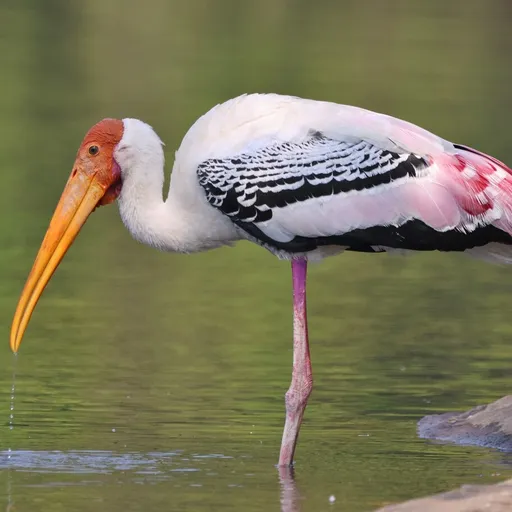
Painted Stork
Mycteria leucocephala
Least Concern
Listen
XC1087478 · Halyn Betchkal · Sultanpur National Park (Hut) Gurugram, Gurgaon Division, Haryana, India · CC0 1.0
Overview
The painted stork (Mycteria leucocephala) is a large wading bird in the stork family, found in the wetlands of the plains of tropical Asia south of the Himalayas. It is classified as Least Concern on the IUCN Red List, although populations in certain regions like Pakistan are endangered.
Identification
- Adults feature a heavy yellow beak with a down-curved tip and a bare, orange or reddish head.
- Distinctive pink-tipped tertials extend over the back and rump, while a black breast band with white scaly markings continues into the under-wing coverts.
- Primaries and secondaries are black with a greenish gloss, and the body is otherwise whitish.
- Medium-sized for a stork, standing 93–102 cm tall with a wingspan of 150–160 cm.
Habitat
This species inhabits freshwater wetlands across the Indian subcontinent and Southeast Asia, extending from the Indus River system eastward. It prefers shallow waters such as rivers, lakes, irrigation canals, and flooded rice fields, avoiding dry deserts, dense forests, and high hill regions.
Diet
Painted storks forage in flocks by sweeping their half-open beaks from side to side in shallow water to catch small fish by touch. They also stir the water with their feet to flush out hiding prey, and occasionally feed on frogs, crabs, large insects, and snakes.
Did you know?
The species is named for the pink tertial feathers of adults, but they also exhibit urohidrosis, a behaviour where they defecate on their highly vascularised legs to cool themselves down during hot weather.
Sources
- Wikipedia · CC BY-SA 4.0
- Wikidata · CC0 1.0