
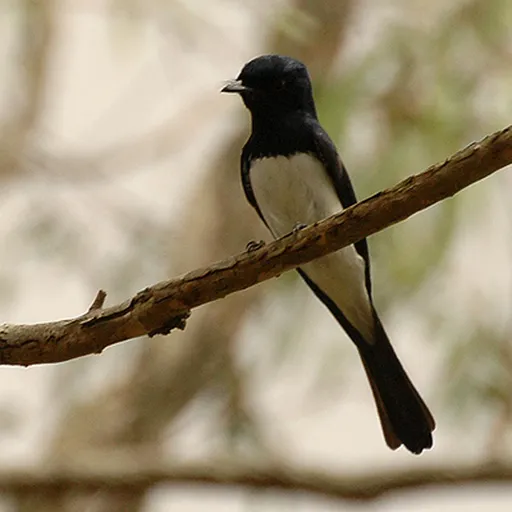
Satin Flycatcher
Myiagra cyanoleuca
Least Concern
Overview
The satin flycatcher, Myiagra cyanoleuca, is a small passerine bird in the family Monarchidae. It is characterised by strong sexual dimorphism and a glossy, 'satin' appearance in males. Although currently listed as Least Concern, its population is declining along the eastern Australian seaboard due to habitat loss and predation by introduced Red Foxes.
Identification
- Males feature glossy, blue-black upperparts contrasting with white underparts and possess a small head crest.
- Females are dusty brown-grey with a bright orange throat and chest, also having a white belly.
- The bird is small, approximately 17 cm in length and 17 g in weight, with a small, sharp, pointed beak.
- It often stands upright and spreads its tail feathers into a 'fan' shape.
Habitat
This species is most common in south-eastern Australia, particularly breeding in the warmer months. It resides year-round on the east coast of New South Wales and Queensland, extends into South Australia and Papua New Guinea, and occasionally occurs as a vagrant in New Zealand.
Diet
The satin flycatcher feeds on small invertebrates and insects, using its small, sharp, pointed beak to catch them. Specific foraging techniques or detailed hunting behaviours are not described in the provided references.
Did you know?
The female of this species closely resembles the Broad-billed flycatcher, making the two difficult to distinguish by appearance alone. However, their ranges separate them, as the satin flycatcher is far more common in the south-east, whereas the similar species are found in Queensland and the Northern Territory.
Sources
- Wikipedia · CC BY-SA 4.0
- Wikidata · CC0 1.0