
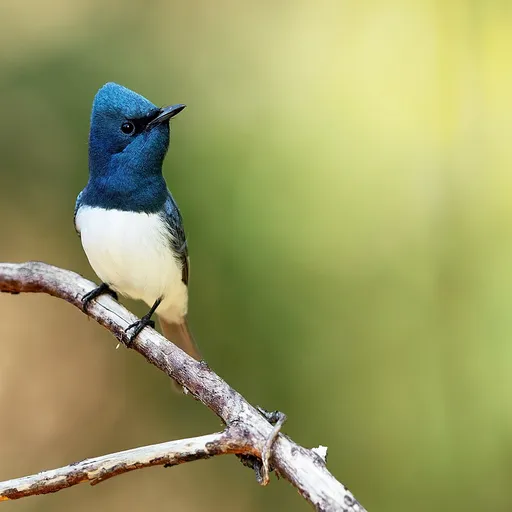
Leaden Flycatcher
Myiagra rubecula
Least Concern
Listen
XC456645 · James Ray · Faulconbridge, Blue Mountains City Council, New South Wales, Australia · CC BY-SA 4.0
Overview
The leaden flycatcher (Myiagra rubecula) is a small passerine bird belonging to the family Monarchidae. It is classified as Least Concern by the IUCN Red List. The species was first described by John Latham in 1801, who originally named it the red-breasted tody.
Identification
- 14.5–16 cm in length, weighing around 10–15 g, with a bluish black bill, black legs, and dark brown iris.
- Males feature a lustrous azure or shiny lead-grey body with white underparts and darker grey lores.
- Females possess a leaden head, mantle, and back with an orange-tan (rufous) throat and breast, and a white belly.
- Juveniles resemble adult females but display paler wing-edges.
Habitat
Found across eastern and northern Australia, Indonesia, and Papua New Guinea, the species inhabits subtropical and tropical mangrove forests in the north, shifting to eucalypt woodland, sclerophyll forest, rainforest margins, and coastal scrub in the south and inland. It is highly migratory within this range, extending from King Sound down to central-southern Victoria, where it is rare in Tasmania.
Diet
As an insectivore, the leaden flycatcher is a very active and agile bird that hops between branches to catch insects in flight.
Did you know?
Locals in Sydney refer to the species as a 'frogbird' due to its guttural call. Additionally, its breeding success is notably low, with only 23% of nests successfully fledging a chick.
Sources
- Wikipedia · CC BY-SA 4.0
- Wikidata · CC0 1.0