
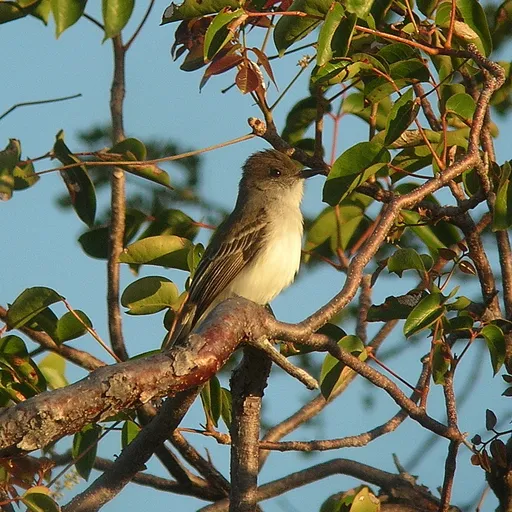
Puerto Rican Flycatcher
Myiarchus antillarum
Least Concern
Overview
The Puerto Rican flycatcher (Myiarchus antillarum) is a species of tyrant flycatcher found in Puerto Rico, the American Virgin Islands, and the British Virgin Islands. Known locally as juí, this bird is considered a year-round resident in its native habitats and is currently classified as a species of Least Concern by the IUCN.
Identification
- Length of 16 to 18 cm with a weight of 20.5 to 27.5 g, featuring similar plumage in both sexes.
- Dark sooty brown crown forming a crest, with olive-brown upperparts and pale gray throat and breast.
- Brown iris, brownish black bill with a brownish base to the mandible, and brownish black legs and feet.
- Most common vocalisation is a 'plaintive whistle whee', with a secondary call of 'whee-a-wit-whee'.
Habitat
This species inhabits deciduous and pine forests, mangroves, coffee plantations, and arid scrublands within the tropical zone from sea level to 800 m. Its range includes Puerto Rico, including the islands of Vieques and Culebra, as well as St. John, St. Thomas, Tortola, and Virgin Gorda in the Virgin Islands.
Diet
Primarily feeds on insects, fruit, and seeds, with occasional consumption of snails and lizards. Foraging usually occurs in the forest canopy, taking prey by gleaning while perched or briefly hovering after a short sally, and also capturing insects in mid-air.
Did you know?
The local name for the bird is juí, and it is traditionally considered a harbinger of both good and bad news. Its nests are frequently parasitised by shiny cowbirds, which lay their eggs in the flycatcher's cavity nests.
Sources
- Wikipedia · CC BY-SA 4.0
- Wikidata · CC0 1.0