
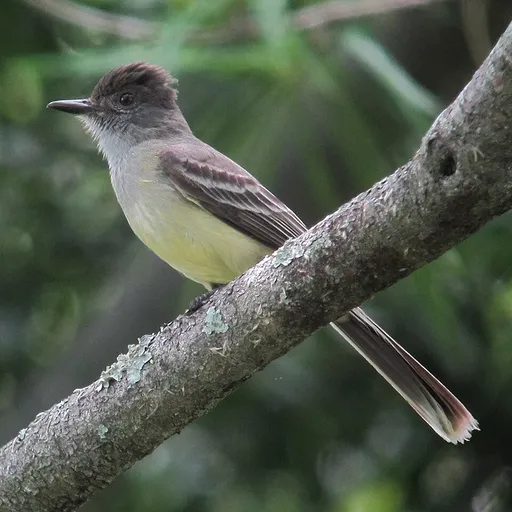
Apical Flycatcher
Myiarchus apicalis
Least Concern
Overview
The apical flycatcher (Myiarchus apicalis) is a slim, medium-sized bird in the tyrant flycatcher family, endemic to Colombia. Classified as Least Concern by the IUCN, it is a year-round resident with a population believed to be increasing due to the expansion of secondary woodland and scrub.
Identification
- A 17 to 18 cm bird with a brownish olive crown featuring a slight crest and darker center feathers that create a streaked appearance.
- Darkish olive upperparts with two distinct wing bars formed by the whitish to yellowish outer edges and tips of the greater and median coverts.
- Gray face, throat, and breast, with an olive wash on the breast sides and yellowish belly and undertail coverts.
- Dark bill, legs, and feet, with a dark iris; juveniles display rufous edges on the wing coverts and tail feathers.
Habitat
This species inhabits a disjunct distribution across the watersheds of the Cauca, Dagua, Patía, and Magdalena rivers in west-central Colombia. It primarily occupies dry to arid valleys with scrubby vegetation, as well as the edges of forests, riparian areas, and agricultural lands. Its elevation range extends from 400 m to 2,500 m, though it is most numerous below 1,700 m.
Diet
The apical flycatcher feeds on insects and fruit, typically foraging singly or in pairs. It captures prey and fruit by making sallies from a perch located between the low and mid-levels of the habitat.
Did you know?
The species derives its name from the Latin word for 'point' or 'tip', specifically referencing the pale creamy tips on its tail feathers. In suburban areas, its nests have been constructed using a mix of natural materials and human refuse, including dry grass, fur, feathers, plastic, and snake skin.
Sources
- Wikipedia · CC BY-SA 4.0
- Wikidata · CC0 1.0