
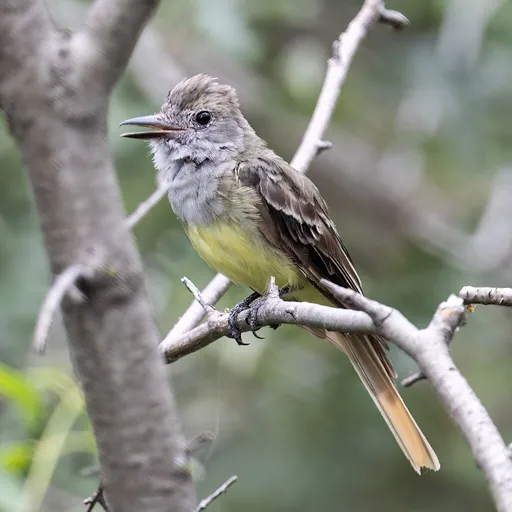
Great Crested Flycatcher
Myiarchus crinitus
Least Concern
Listen
XC636905 · Philip Vanbergen · Parish Governing Authority District 5 (near Washington), St. Landry Parish, Louisiana, United States · CC BY-SA 4.0
Overview
The great crested flycatcher (Myiarchus crinitus) is a large insect-eating bird belonging to the tyrant flycatcher family and is the most widespread member of its genus in North America. It is characterised by its preference for high treetop perches and a broad distribution across the eastern and mid-western United States.
Identification
- Measures 17–21 cm in length with a wingspan of roughly 34 cm and weighs between 27–40 g.
- Brownish upperparts with yellow underparts, a grey throat and breast, and a long rusty brown tail.
- Possesses a bushy crest, with no sexual dimorphism in appearance.
- Song consists of two short whistles (a wheerreep and a whee) followed by a soft low churr, typically heard at dawn.
Habitat
This species primarily inhabits deciduous forests, mixed woodlands, and the edges of clearings, favouring landscapes with an open canopy while avoiding conifer-dominant habitats such as the Canadian boreal forest. Its breeding range covers the eastern, mid-eastern, and parts of central United States, extending into specific southern regions of Canada, with winter quarters in southern Mexico, the Yucatán Peninsula, and along Central American coasts.
Diet
Primarily an insectivore, the great crested flycatcher feeds on butterflies, moths, beetles, grasshoppers, crickets, and bees, though it also consumes small fruits and berries. It employs a sit-and-wait strategy from high canopies, swooping down to catch prey or picking insects and fruits off leaves and trunks.
Did you know?
Males have developed a strategy of attempting copulation with females from the start of nest building until the young hatch, a behaviour thought to serve as a guard against female infidelity.
Sources
- Wikipedia · CC BY-SA 4.0
- Wikidata · CC0 1.0