
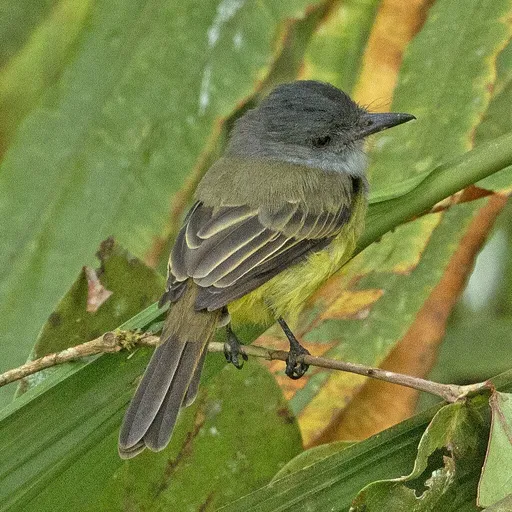
Sooty-crowned Flycatcher
Myiarchus phaeocephalus
Least Concern
Listen
XC249751 · Niels Krabbe · Guayas: Colinas de Engunga, Ecuador · CC BY-SA 4.0
Overview
The sooty-crowned flycatcher, Myiarchus phaeocephalus, is a species of tyrant flycatcher native to Ecuador and Peru. It is considered a year-round resident in its range, where it is uncommon to fairly common. The species is currently assessed as Least Concern by the IUCN, although its population is believed to be decreasing.
Identification
- 18 to 19 cm long with a light blue-gray forehead and forecrown that darkens on the hindcrown and nape.
- Light olive-green back separated from the nape by a unique light gray collar.
- Gray throat and breast with light yellow belly and undertail coverts.
- Song consists of a whistled note combined with low burry trill notes, or a descending wheeé-deee-deee-de-du-du.
Habitat
The species has a disjunct distribution, found from northwestern Ecuador south to northwestern Peru and in the upper Marañón River watershed in southeastern Ecuador and northern Peru. It primarily inhabits dry deciduous woodland and arid scrublands, occasionally at the edges of mangrove forests. Its elevation range is from sea level up to 1,200 m in Peru and 1,100 m in Ecuador.
Diet
The sooty-crowned flycatcher feeds on insects, which it captures by sallying from a perch.
Did you know?
The nest of the sooty-crowned flycatcher is constructed within a tree cavity and lined with an eclectic mix of materials including fur, snake skin, and plastic.
Sources
- Wikipedia · CC BY-SA 4.0
- Wikidata · CC0 1.0