
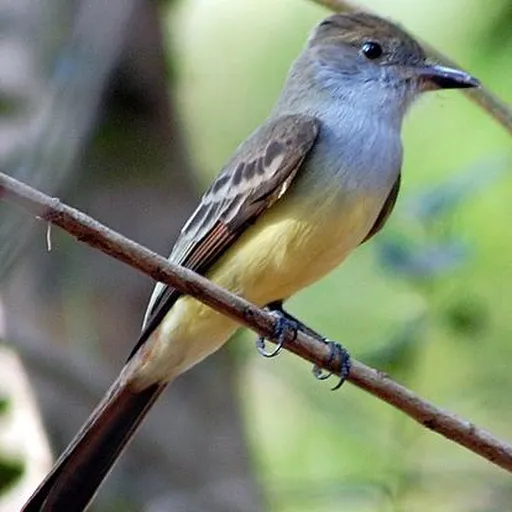
Brown-crested Flycatcher
Myiarchus tyrannulus
Least Concern
Listen
XC754165 · Rosa Elena Albornoz · Cúa (near La Magdalena), Urdaneta, Miranda, Venezuela · CC0 1.0
Overview
The brown-crested flycatcher (Myiarchus tyrannulus) is a passerine bird in the tyrant flycatcher family, characterised by a bushy crest and a wide geographic range. It is classified as Least Concern on the IUCN Red List, with a population believed to be increasing across its extensive distribution.
Identification
- Adults of northern subspecies possess a grayish brown crown with a bushy crest, light brownish gray to dark olive gray upperparts, and bright yellow underparts washed with light gray on the sides.
- Birds measure 18 to 23 cm in length, with the largest subspecies weighing up to 54 g; all have brown irises, black bills, and black legs.
- The dawn song consists of alternated renditions of isolated huits and complex phrases, typically combining a 'whay-burg' note with rapid series of huits, alongside harsh rasps and modulated whistles.
Habitat
Found from the southwestern United States through Mexico and Central America to Costa Rica, as well as in parts of the Caribbean and most mainland South American countries except Chile and possibly Ecuador. The species inhabits diverse landscapes, including riparian zones, desert with large cacti, tropical deciduous forests, savannas, and dryish woodlands, generally utilising large cavities in trees or cacti for nesting.
Diet
During the breeding season, the bird feeds almost exclusively on arthropods, occasionally consuming small vertebrates and fruit. In the non-breeding season, it consumes a more even mix of arthropods and fruit. Foraging primarily involves taking prey from vegetation via sallies from a perch, with less frequent mid-air or ground foraging.
Did you know?
The nesting material for this species can include anthropogenic items such as fabric and plastic, alongside natural elements like plant fibers, hair, and snake skin.
Sources
- Wikipedia · CC BY-SA 4.0
- Wikidata · CC0 1.0