
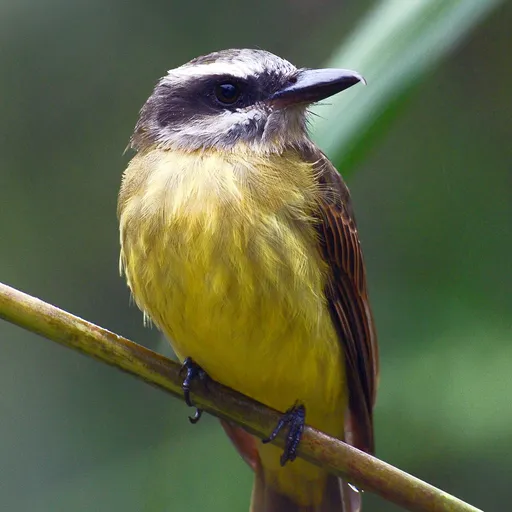
Golden-crowned Flycatcher
Myiodynastes chrysocephalus
Least Concern
Listen
XC249375 · Niels Krabbe · Napo: km 11.6 Narupa-Loreto road, Ecuador · CC BY-SA 4.0
Overview
The golden-crowned flycatcher (Myiodynastes chrysocephalus) is a species of tyrant flycatcher found in South America. It is classified as a species of Least Concern by the IUCN, with a population believed to be increasing.
Identification
- Adults possess a brownish gray to dusky crown featuring a usually hidden golden-yellow patch in the centre, along with a long white supercilium.
- Upperparts are dull olive with a greenish olive rump, while underparts range from buffy yellow to pale yellow with central suffusion and olive streaks.
- The bird measures 18.5 to 22 cm in length and has a stout black bill and blackish legs.
- Its dawn song is described as a loud, squeaky 'REE'chewee?', and its call is a metallic, slightly squeaky 'rew-TCHI?'.
Habitat
Found on the eastern slope of the Andes ranging from northern Peru through central Bolivia into northwestern Argentina, this species inhabits the edges and canopy of foothill and montane forests, as well as cloud forest. It favours openings in the forest, whether natural or human-made, and is often seen along roads and watercourses at elevations between 350 and 3,100 m.
Diet
The golden-crowned flycatcher feeds on insects and fruit, typically foraging singly or in pairs, though it may occasionally join mixed-species feeding flocks without following them. It perches from lower to mid-levels in the forest and captures prey by hawking in mid-air or by making short upward sallies to glean from vegetation while briefly hovering.
Did you know?
The species has a complex taxonomic history, resulting in its current monotypic status after subspecies were reclassified as the golden-bellied flycatcher. Photographs suggest its eggs are slightly glossy creamy white with dark cinnamon flecks, streaks, and blotches, similar to those of its sister species.
Sources
- Wikipedia · CC BY-SA 4.0
- Wikidata · CC0 1.0