
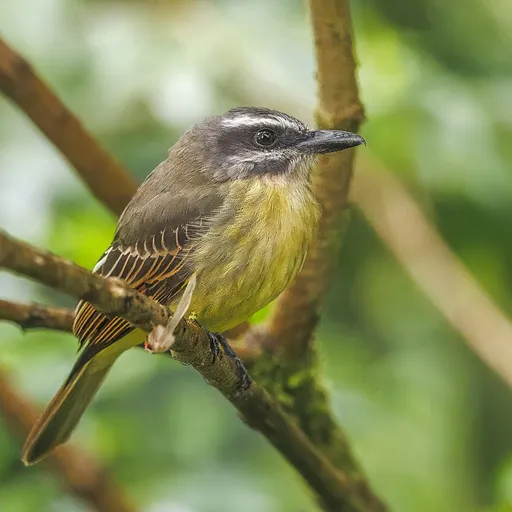
Golden-bellied Flycatcher
Myiodynastes hemichrysus
Least Concern
Listen
XC1070395 · Rosa Elena Albornoz @rosaelena_naturaleza · San Antonio De Los Altos (near Parroquia Macarao), Municipio Los Salias, Miranda, Venezuela · CC0 1.0
Overview
The golden-bellied flycatcher (Myiodynastes hemichrysus) is a passerine bird in the family Tyrannidae. It is found across Central and South America, with a disjunct distribution ranging from Costa Rica and Panama through the Andes of Colombia, Ecuador, and Peru to northern Venezuela. The species is assessed as Least Concern on the IUCN Red List.
Identification
- Length of 20 to 22 cm with a weight of 39 to 42.5 g, featuring a stout black or brownish black bill and dusky gray legs.
- Upperparts are mostly olive green with a dusky grayish olive or dark sooty gray crown, often hiding a large yellow patch in the centre.
- Underparts consist of a canary-yellow throat and deep lemon-yellow belly with faint olive streaks, contrasted by a wide white supercilium and blackish stripe through the lores.
- Vocalisations include a dawn song of 'kwee!-tee-tu' and a day song of loud, strident 'skeeew!'s, typically sung from a perch in the canopy.
Habitat
This species inhabits the canopy and edges of humid to wet montane forests, particularly cloudforest, in the upper tropical and subtropical zones. It is also common along roads, watercourses, and at the edges of natural or human-made clearings, extending to plantations and other modified habitats. Elevation ranges vary by location, from 600 to 2,300 m in Venezuela up to 2,900 m in Colombia.
Diet
The golden-bellied flycatcher feeds on insects and fruit, showing a particular preference for adult butterflies and moths. It usually forages in pairs or small family groups, rarely joining mixed-species flocks, and perches from the mid-level to near the crown of a tree. It captures prey by making short upward sallies to glean from vegetation or by hawking insects in mid-air.
Did you know?
The female constructs shallow open cup nests from rootlets and thin fibers, which are placed in diverse locations such as epiphytes high on branches or in niches on earthen banks and cliff faces. Only one observation on record shows both parents provisioning young, as details of parental care remain largely unknown.
Sources
- Wikipedia · CC BY-SA 4.0
- Wikidata · CC0 1.0