
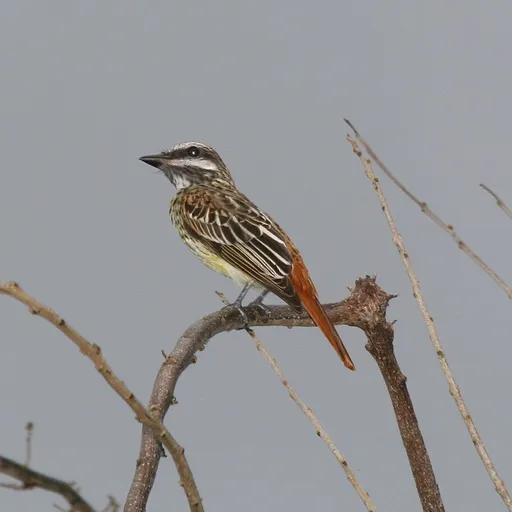
Sulphur-bellied Flycatcher
Myiodynastes luteiventris
Least Concern
Overview
The sulphur-bellied flycatcher (Myiodynastes luteiventris) is a large member of the tyrant flycatcher family, Tyrannidae. It is regularly found from southern Arizona in the United States south to Bolivia, with casual occurrences as a vagrant further north, east, and south. The species is currently assessed as Least Concern by the IUCN Red List due to its extensive range and stable population.
Identification
- Adults possess a pale hoary gray or grayish white forecrown and supercilium, contrasting with a brownish gray to olive crown that features a large, usually hidden, canary-yellow patch.
- Underparts are primrose-yellow to sulphur-yellow, marked with wide coarse black or dusky streaks on the breast and thinner streaks on the sides and flanks.
- The bird measures approximately 20 cm (7.9 in) in length and weighs between 40 and 57 g (1.4 to 2.0 oz), with dusky or blackish bills and plumbeous or black legs.
- Males sing a soft, liquid, almost warbled 'tre-le-re-re' or a clipped, slightly liquid phrase described as 'chee-a-leet s-lik' or 'chew-ee ti-lit', accompanied by a 'screech' call compared to the protest of a wagon wheel needing oiling.
Habitat
In its breeding range, the sulphur-bellied flycatcher inhabits deciduous forest, gallery forest, and the edges of evergreen forest in tropical and subtropical zones, typically residing in riparian canyons in Arizona. During migration, it favours somewhat open woodlands and the edges of denser forest, while on wintering grounds it mostly inhabits forest along rivers as well as disturbed and secondary forest. Elevation preferences vary by region, ranging from sea level to approximately 2,200 m in parts of Central America and South America.
Diet
The sulphur-bellied flycatcher feeds on insects year-round, adding much fruit to its diet during the non-breeding season. It is assumed to forage by perching in trees from mid-height to the canopy, taking insect prey via sallies to glean, brief hovers, or mid-air hawking, while most fruits are taken by gleaning while perched.
Did you know?
The male's 'screech' call is often compared to the sound of a wagon wheel that needs oiling, while another vocalisation is described as an excited, piercing 'squeezy-toy'-like 'wee'iz-uh'. Only males of the species sing the complex liquid phrases, whereas the female is solely responsible for building the nest and incubating the eggs.
Sources
- Wikipedia · CC BY-SA 4.0
- Wikidata · CC0 1.0