
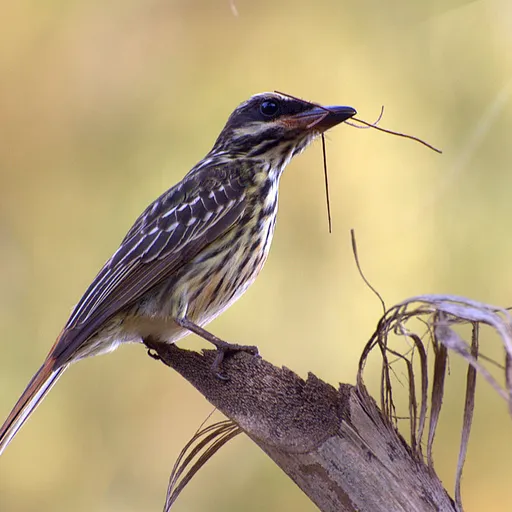
Streaked Flycatcher
Myiodynastes maculatus
Least Concern
Listen
XC776353 · Flávio C.T. Lima · Campinas, Campinas, São Paulo, Brazil · CC0 1.0
Overview
The streaked flycatcher (Myiodynastes maculatus) is a passerine bird in the family Tyrannidae. It is found across Mexico, most of South America, and Trinidad and Tobago, though it is considered a vagrant to Chile and Bonaire.
Identification
- Size 20.5 to 23 cm long, with a large, partially hidden bright yellow to orange-yellow patch in the centre of the crown.
- Dark mask formed by black lores extending to ear coverts, contrasting with a dull white to yellowish-white supercilium.
- Upperparts are greyish brown to olive with buffy edges, giving a streaked appearance, while wings and tail are cinnamon-rufous with dusky or black streaks.
- Lowerparts are mostly white with yellowish flanks and heavier streaks on the throat, breast, and flanks.
- Northern populations sing a complex song described as 'cheer-o-wee-wee' or 'right-here-to-me', while southern populations produce a 'squeaky reEET tiWICHu'whit'.
Habitat
The species inhabits the canopy and edges of a variety of forested landscapes in the tropical and lower subtropical zones, including evergreen and deciduous forest, gallery forest, mangroves, and clearings with tall trees. Its range varies by subspecies, spanning from Mexico and Central America through most of South America, with elevations ranging from sea level to 2,100 m in Bolivia.
Diet
Feeding mostly on insects including large cicadas, locusts, and beetles, the diet also includes berries, other fruits, and occasionally small lizards. It forages mostly from the forest's mid-level to the canopy, catching insect prey in mid-air with short sallies from a perch, or by hovering and gliding.
Did you know?
Although the species generally nests in tree cavities, nests have also been found in bromeliad masses, in openings in vine tangles, in nest boxes, under the eaves of human structures, and extremely rarely in the open on a branch.
Sources
- Wikipedia · CC BY-SA 4.0
- Wikidata · CC0 1.0