
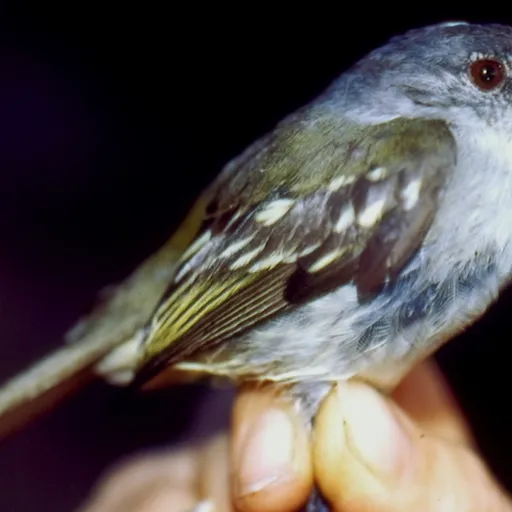
Foothill Elaenia
Myiopagis olallai
Least Concern
Listen
XC250304 · Erik Moelgaard · Zamora-Chinchipe: Río Bombuscaro, Ecuador · CC BY-SA 4.0
Overview
The foothill elaenia (Myiopagis olallai) is a species of tyrant flycatcher characterised by a disjunct distribution across the Andean region of Colombia, Ecuador, Peru, and Venezuela. Currently listed as Least Concern by the IUCN, the species is nonetheless believed to be declining in population size due to habitat loss.
Identification
- Small bird measuring 12 to 12.5 cm in length, with dark grey crown and olive green upperparts.
- Underparts are sulphur yellow with olive markings on the throat and breast in the nominate subspecies, though this varies by subspecies.
- Wings are dusky with pale yellow edges on flight feathers, forming three distinct bars on the closed wing.
- Brown iris, blackish bill with a greyish base, and blackish legs; song consists of rapid, descending or rising trilled 't'teerrr' notes.
Habitat
This species inhabits the interior and edges of humid montane forest at elevations ranging from approximately 900 m to 1,500 m depending on the region. It has a disjunct distribution, found on the east side of the Andes in Ecuador and southern Peru, as well as in the northern Central Andes of Colombia and the Serranía del Perijá on the Venezuela-Colombia border.
Diet
The foothill elaenia feeds on insects, typically foraging in pairs associated with mixed-species feeding flocks. It operates in the forest's mid-level to the canopy, capturing prey by briefly hovering after a short sally from a perch.
Did you know?
Despite its current IUCN status of Least Concern, the foothill elaenia was previously classified as Vulnerable in 2011 and is considered very vulnerable to habitat loss, as its narrow elevational band along the lower eastern Andean slopes is disappearing rapidly due to clearing for subsistence agriculture.
Sources
- Wikipedia · CC BY-SA 4.0
- Wikidata · CC0 1.0