
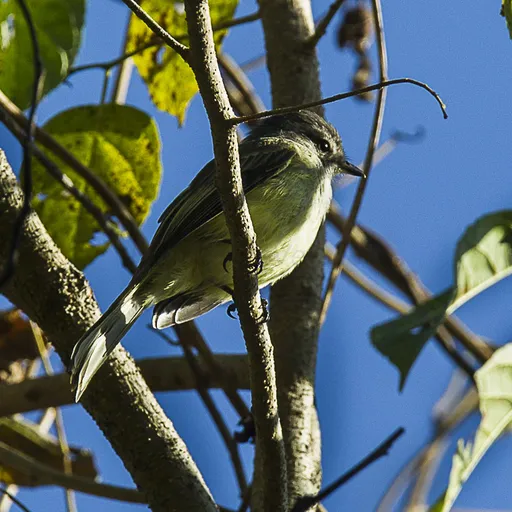
Pacific Elaenia
Myiopagis subplacens
Least Concern
Listen
XC250092 · Niels Krabbe · Azuay: upper Yunguilla Valley, Ecuador · CC BY-SA 4.0
Overview
The Pacific elaenia, Myiopagis subplacens, is a species of tyrant flycatcher found in Ecuador and Peru. It is currently assessed as being of Least Concern by the IUCN, with a population that is believed to be decreasing despite no immediate threats being identified.
Identification
- Approximately 14 cm in length, with males averaging 14.9 g and females 16.9 g.
- Adults feature a gray-brown crown with a partially concealed bright yellow stripe, whitish lores, and a partial white eyering.
- Upperparts are brownish olive with dusky wings showing pale yellow edges on inner flight feathers and yellowish tips on coverts, forming two faint bars.
- Throat and breast are pale grayish with white streaks, while the belly is pale yellow; both sexes have a black bill with a pinkish or dirty white base and black or dark gray legs.
- Dawn song consists of an endlessly repeated 'chrrr, chrrr, che-wik' phrase, and daytime song includes a sharp, burry 'PJIT! djurrrree' with the second note rising.
Habitat
Found in the Pacific lowlands and foothills from western Esmeraldas Province in northern Ecuador south to Lambayeque and southwestern Cajamarca in Peru. It inhabits somewhat dry to semi-humid deciduous forest, secondary forest near older forest, and tall scrub, reaching elevations of 1,700 m in Ecuador and 1,800 m in Peru.
Diet
The diet is known to include insects and small fruits, though specific details remain unstudied. The species typically forages singly or in pairs in the forest canopy and seldom joins mixed-species feeding flocks.
Did you know?
The Pacific elaenia was originally described as Elaenia subplacens but was moved to the genus Myiopagis in the mid-twentieth century, a classification later confirmed by genetic analysis.
Sources
- Wikipedia · CC BY-SA 4.0
- Wikidata · CC0 1.0