
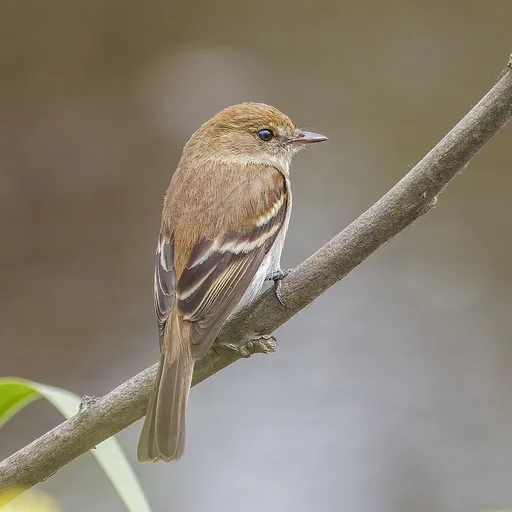
Bran-colored Flycatcher
Myiophobus fasciatus
Least Concern
Listen
XC754198 · Rosa Elena Albornoz · Nuestra Señora del Rosario de Baruta (near Caracas), Baruta, Distrito Capital, Venezuela · CC0 1.0
Overview
The bran-colored flycatcher (Myiophobus fasciatus) is a small passerine bird in the tyrant flycatcher family. It is classified as Least Concern on the IUCN Red List due to its extremely large range and population believed to be increasing.
Identification
- Length 11 to 14 cm with a weight of 7.1 to 17 g, featuring reddish brown upperparts and dull white underparts heavily streaked with grayish brown on the breast and flanks.
- Distinctive head markings include a reddish brown crown, possibly with a hidden yellow to orange-rufous patch in males, brown lores, a short yellowish white line above the lores, and a thin white eye-ring.
- Wings are dusky to dark brown with buff edges on the flight feathers and wide buff-white tips on the wing coverts that show as two wing bars; legs and feet are black.
- Vocalisations vary geographically, such as a whistled 'whee, whee, whee...' in Costa Rica or a husky, whistled 'tep, chew-e' at dawn in Venezuela.
Habitat
Inhabits a variety of somewhat open landscapes across a disjunct range in Central and South America, including the interior and edges of dry forest, brushy savanna, pastures, and thickets along watercourses in arid areas. Also found in successional vegetation on riverbanks, islands, and the Llanos of Colombia and Venezuela, at elevations ranging from sea level to 2,000 m depending on the region.
Diet
The diet is known to be primarily insects and a lesser amount of small berries. It typically forages singly or in pairs within about 2 m of the ground, seldom joining mixed-species feeding flocks, and takes prey from foliage and twigs while perched or with short flights to hover-glean.
Did you know?
The species tends to thrive in shrubby successional vegetation that follows deforestation rather than requiring primary forest. Its nests are constructed solely by the female using plant fibers held together with spider web, occasionally incorporating green moss or feathers.
Sources
- Wikipedia · CC BY-SA 4.0
- Wikidata · CC0 1.0