
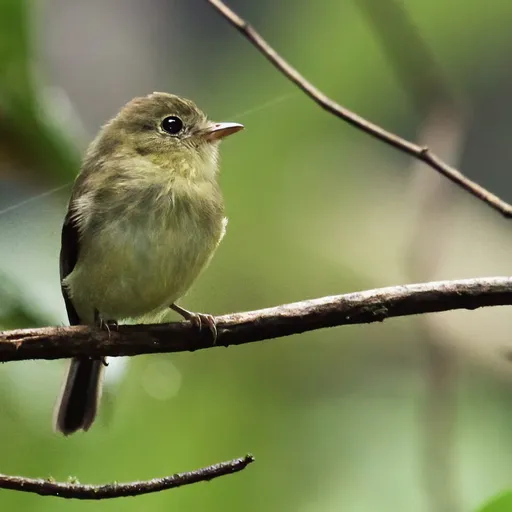
Orange-crested Flycatcher
Myiophobus phoenicomitra
Least Concern
Listen
XC249810 · Niels Krabbe · Morona-Santiago: w-slope Cord. de Cutucú, Ecuador · CC BY-SA 4.0
Overview
The orange-crested flycatcher (Myiophobus phoenicomitra) is a small tyrant flycatcher found in the Andean regions of Colombia, Ecuador, and Peru. It is a year-round resident of humid forest habitats and is currently assessed as being of Least Concern by the IUCN, though its population is believed to be decreasing.
Identification
- Length of 11.5 to 12 cm with an olive crown and a mostly hidden orange-rufous patch in the middle, a feature absent in females.
- Bright yellow throat and underparts, with the belly being the brightest and faint olive streaks on the breast.
- Blackish wings with cinnamon edges and ochraceous tips on the coverts, forming two or three distinct wing bars.
- A fairly broad bill with a black upper part and pinkish lower part, along with black or dark gray legs.
- A weak, thin, high-pitched song described as 'tsut-tseép-tsu' in Ecuador.
Habitat
This species inhabits the interior and edges of humid forest in the foothills and subtropical zones, typically found below 1,550 m in Colombia, between 600 and 1,550 m in Ecuador, and between 1,100 and 1,400 m in Peru. It has a disjunct distribution on both the eastern and western slopes of the Andes.
Diet
It feeds on arthropods, usually foraging alone or in pairs within the forest understory. The bird takes prey in mid-air or from foliage, twigs, and the ground by making short flights from perches where it maintains an erect posture.
Did you know?
Despite extensive range overlap with the closely related flavescent flycatcher, the orange-crested flycatcher is generally found at lower elevations, while its relative prefers higher altitudes.
Sources
- Wikipedia · CC BY-SA 4.0
- Wikidata · CC0 1.0