
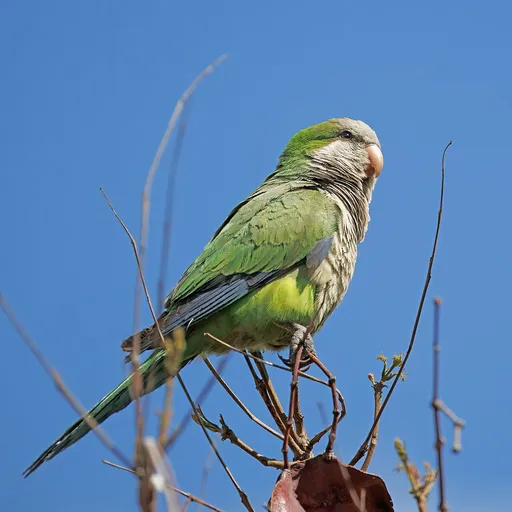
Monk Parakeet
Myiopsitta monachus
Least Concern
Listen
XC1143450 · Tanguy Loïs · Comarca Metropolitana de Sevilla (near Seville), Seville, Andalusia, Spain · CC BY-SA 4.0
Overview
The monk parakeet (Myiopsitta monachus), also known as the Quaker parrot, is a small to medium-sized true parrot native to temperate and subtropical South America. As one of the few temperate-zone parrots, it has established self-sustaining feral populations in North America, Europe, and other regions with similar climates.
Identification
- Size: Approximately 29 cm in length with a 48 cm wingspan, weighing between 95 and 120 g.
- Plumage: Bright green upperparts with a pale grey forehead and breast featuring darker scalloping; underparts are very light green to yellow.
- Wings and Tail: Dark blue flight feathers (remiges) and a long, tapering tail.
- Vocalisation: Loud, throaty calls described as chape(-yee), quak quaki quak-wi quarr, or skveet.
Habitat
Native to temperate and subtropical areas of South America, specifically Argentina, Brazil, Paraguay, and Uruguay. The species has spread to feral populations in North America, Europe, the Middle East, and parts of Asia, often nesting on warm electrical equipment in urban environments.
Diet
Primarily herbivorous, the monk parakeet feeds on seeds, fruits, vegetables, and grains. Although technically omnivorous, they also consume insects and worms.
Did you know?
Unique among most nesting parrots, monk parakeets construct large, external nests in trees or man-made structures rather than using tree cavities. These composite nests can reach the size of a small automobile and often house multiple pairs, or even other species such as pigeons and red squirrels.
Sources
- Wikipedia · CC BY-SA 4.0
- Wikidata · CC0 1.0