
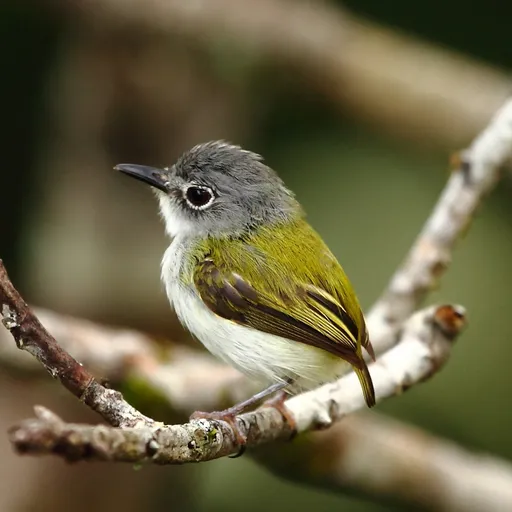
Short-tailed Pygmy Tyrant
Myiornis ecaudatus
Least Concern
Overview
The short-tailed pygmy tyrant (Myiornis ecaudatus) is a species of tyrant flycatcher classified as Least Concern on the IUCN Red List. It holds the distinction of being the smallest passerine bird on Earth, measuring only 6 to 7 cm in length and weighing approximately 4.2 g.
Identification
- Size and Build: The smallest passerine on Earth at 6–7 cm long; its extremely short, black tail and compact body often lead to it being mistaken for a large beetle or insect, particularly in flight.
- Plumage and Markings: Adults feature a mostly dark grey head with a prominent white spot above the lores and a white eye-ring, creating a spectacled appearance, while the back, rump, and uppertail coverts are bright olive green.
- Bill and Legs: Possesses an unusually long black bill relative to its small body size, supported by pinkish legs and feet.
- Vocalisation: Vocalisations are frequently compared to the sounds of insects and frogs, including a soft trilled, purr-like call that may accelerate into short, squeaky 'creek' notes.
Habitat
Primarily a bird of the Amazon Basin, this species also ranges across Trinidad and most mainland South American countries, with the exception of Argentina, Chile, Paraguay, and Uruguay. It inhabits the interior, edges, and gaps of humid forests, as well as nearby secondary and transitional forests in lowlands and Andean foothills, typically below 1,000 m in elevation.
Diet
Feeds exclusively on insects, foraging typically in the forest canopy though descending lower at edges and gaps. It captures prey using short upward sallies from perches to grab items from leaves, and occasionally gleans prey while briefly hovering after a short flight.
Did you know?
Despite being a bird, the short-tailed pygmy tyrant is so minute and its movements so erratic that observers are much more likely to mistake it for a large beetle or insect, especially when in flight, than to recognise it as a member of the avifauna.
Sources
- Wikipedia · CC BY-SA 4.0
- Wikidata · CC0 1.0