
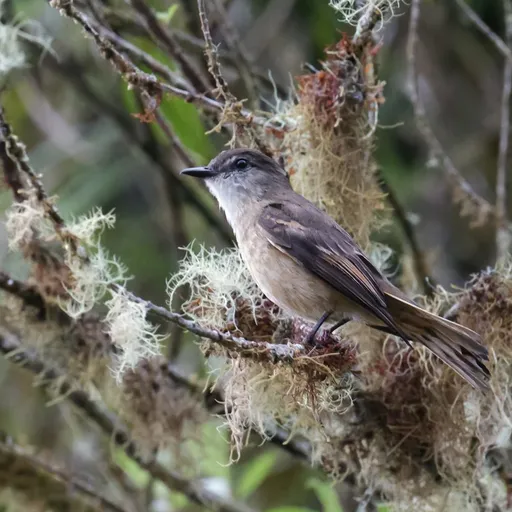
Rufous-bellied Bush Tyrant
Myiotheretes fuscorufus
Least Concern
Overview
The rufous-bellied bush tyrant (Myiotheretes fuscorufus) is a species of tyrant flycatcher that is currently classified as Least Concern on the IUCN Red List. Although its population is believed to be decreasing, it is considered common overall and has a large range on the eastern slopes of the Andes.
Identification
- Size ranges from 18 to 19 cm in length with a weight between 26 and 36 g, and both sexes share identical plumage.
- Features a faint grayish supercilium on a brown face, brown upperparts, and a white-to-pale tawny buff throat transitioning to a tawny buff or rufous breast and belly.
- Wings are mostly blackish with rufous basal halves on the inner webs of flight feathers, creating two wing bars, and pale cinnamon edges on secondaries.
- Song is described as a vigorous 'pip-pip-pip pi-DOO' where the pip notes vary in number, while calls are a rising-falling series of rich pip notes.
Habitat
This species inhabits the canopy and edges of humid montane forests, showing a partiality to disturbed forest and second growth. It ranges along the eastern Andes from the Huánuco Department in central Peru down to the western Santa Cruz Department in Bolivia, occupying elevations between 2,200 m and 3,400 m in Peru and 2,200 m to 2,600 m in Bolivia.
Diet
Feeding details are limited, but the rufous-bellied bush tyrant consumes insects. It typically forages singly, in pairs, or in small family groups by hawking and gleaning with sallies from a high perch, and occasionally joins mixed-species feeding flocks that may include the smoky bush tyrant.
Did you know?
The species was first formally described in 1876 under the genus Ochthodiaeta, a name that was subsequently merged into Xolmis before the bird was finally recognised in its current genus, Myiotheretes.
Sources
- Wikipedia · CC BY-SA 4.0
- Wikidata · CC0 1.0