
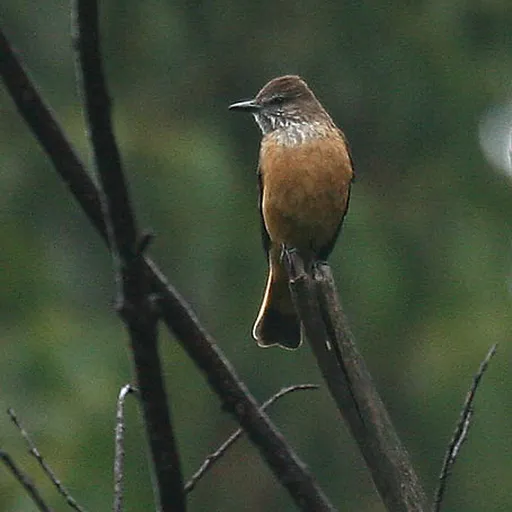
Streak-throated Bush Tyrant
Myiotheretes striaticollis
Least Concern
Listen
XC248445 · Niels Krabbe · Pichincha: Laguna Negra, Mojanda Mts., Ecuador · CC BY-SA 4.0
Overview
The streak-throated bush tyrant (Myiotheretes striaticollis) is a species of tyrant flycatcher classified as Least Concern by the IUCN. It possesses a disjunct distribution across the Andes and related highland ranges in South America, comprising two distinct subspecies.
Identification
- Length of 21 to 23 cm with a weight of approximately 64 g, featuring a large, slightly hooked blackish bill and dark brown irises.
- Dark brown face with a faint whitish stripe from the lores past the eye, and upperparts that are slightly lighter brown.
- White throat heavily streaked with black that continues onto the pale brown upper breast, contrasting with cinnamon-rufous lower underparts.
- Wings are mostly dusky with cinnamon-rufous edges and bases that form a prominent band in flight, while the tail is dusky above and cinnamon below with a blackish outer third.
Habitat
This species inhabits semi-open to open landscapes such as shrublands, grasslands, agricultural areas with shrubby patches, and the edges of forests near cliffs or roads, while shunning the interior of large forests. It is found in the Andes of Colombia, Venezuela, Ecuador, Peru, and Bolivia, extending into northwestern Argentina, typically at elevations between 2,100 and 3,400 m, though it can occur as low as 500 m in Peru.
Diet
The bird feeds on insects and small vertebrates, typically foraging singly or in pairs that often remain somewhat separated. It perches in exposed positions to hawk prey in mid-air with sallies that frequently return to the same perch, or drops to the ground to capture other prey.
Did you know?
The vocalisations of the streak-throated bush tyrant are described as unmistakably human in quality, consisting of loud, clear whistles such as "püEEET" or "HEEE'wit" that resemble human speech. Its nesting behaviour is also distinctive, as it constructs an open cup nest often placed under a bridge or a natural or human-made overhang.
Sources
- Wikipedia · CC BY-SA 4.0
- Wikidata · CC0 1.0