
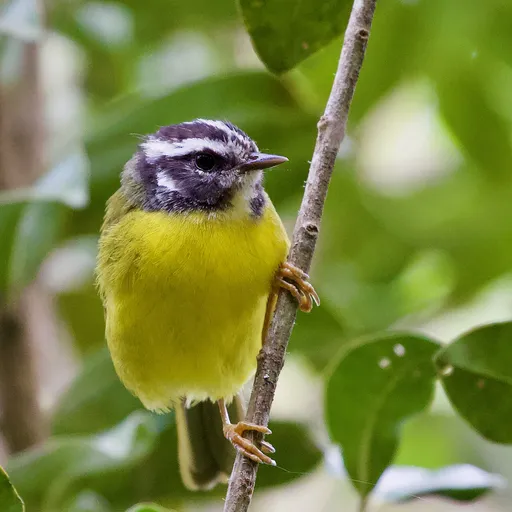
Santa Marta Warbler
Myiothlypis basilica
Near Threatened
Overview
The Santa Marta warbler (Myiothlypis basilica) is a Near Threatened species of New World warbler endemic to the Sierra Nevada de Santa Marta in northern Colombia. It is a sedentary, year-round resident that inhabits the understory of humid stunted forests.
Identification
- 14 to 15 cm long with identical plumage in both sexes.
- Black head featuring a white central crown, long and wide supercilium, crescent under the eye, crescent on the ear coverts, and a yellow throat.
- Olive-green upperparts, wings, and tail with yellow underparts.
- Dark iris, blackish bill, and dull pinkish legs and feet.
- Song described as a fast, high chatter; call is a short, weak trill.
Habitat
Found exclusively in the isolated mountain range of the Sierra Nevada de Santa Marta, northern Colombia. It occupies the understory and edges of humid stunted forest in the temperate zone between 2,200 and 3,000 m elevation, with a particular preference for stands of Chusquea bamboo.
Diet
The diet is believed to consist entirely or almost entirely of invertebrates. Foraging occurs in pairs or small groups that frequently join mixed-species feeding flocks, primarily by gleaning in the forest's lower levels below approximately 4 m.
Did you know?
Although the species is considered locally common, its estimated population of 1,000 to 3,000 mature individuals is considered stable, and it may persist in scrubby habitat above the tree line, suggesting some tolerance of deforestation.
Sources
- Wikipedia · CC BY-SA 4.0
- Wikidata · CC0 1.0