
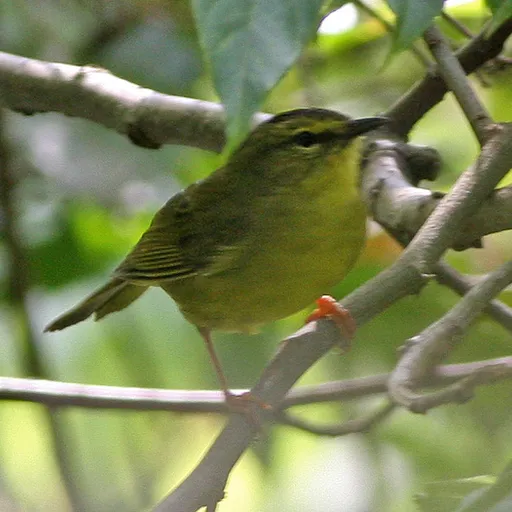
Two-banded Warbler
Myiothlypis bivittata
Least Concern
Overview
The two-banded warbler is a New World warbler found in South America, classified as Least Concern by the IUCN. Its taxonomy is currently unresolved, with some authorities splitting it into two distinct species based on genetic and vocal differences. The species is a sedentary year-round resident that is considered locally fairly common to abundant across its range.
Identification
- A small bird measuring 12.5 to 14 cm in length and weighing 11 to 17 g, with blackish brown upper mandibles and brown lower mandibles.
- Adults of the nominate subspecies display a black crown with an orange-rufous central stripe, a yellow supercilium forming a crescent over the eye, and an olive-green back with mostly yellow underparts.
- Dark brown irises and yellowish brown to yellowish pink legs and feet are present across all subspecies.
- The song varies by subspecies, ranging from bouncy tic notes and stuttering rhythms in the north to deep, rich, accelerating warbles and duets in the south.
Habitat
The two-banded warbler inhabits humid primary and secondary forests as well as dry, humid, and wet forest types, often favouring dense understories and bamboo thickets. Its range covers parts of Argentina, Bolivia, Brazil, Guyana, Peru, and Venezuela, though it has a disjunct distribution with significant gaps between subspecies. Elevation ranges vary by region, typically between 300 and 2,200 m.
Diet
The diet of the two-banded warbler has not been formally studied but is believed to consist mostly or entirely of invertebrates. Pairs and family groups forage in the forest understory between 2 and 10 m above the ground, occasionally reaching the canopy. They primarily glean prey from vegetation and branches, rarely joining mixed-species feeding flocks.
Did you know?
The taxonomic status of the two-banded warbler remains in flux, with some systems recognising it as a single species of three subspecies while others have split it into two separate species due to high genetic divergence and distinct songs. This classification uncertainty is maintained because the split is deferred pending the publication of current research.
Sources
- Wikipedia · CC BY-SA 4.0
- Wikidata · CC0 1.0