
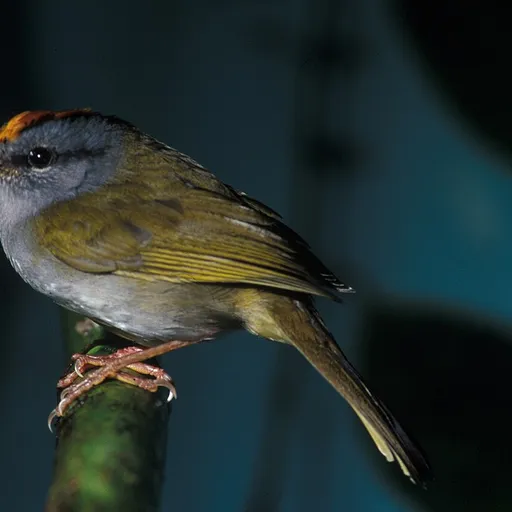
Russet-crowned Warbler
Myiothlypis coronata
Least Concern
Listen
XC251196 · Niels Krabbe · Azuay: upper Yunguilla Valley, Ecuador · CC BY-SA 4.0
Overview
The russet-crowned warbler (Myiothlypis coronata) is a species of bird in the family Parulidae, commonly known as the New World warblers. It is a sedentary year-round resident found across the Andean ranges of South America.
Identification
- Size and weight: Approximately 14 cm (5.5 in) long, weighing between 13.5 and 19.5 g.
- Plumage: Adults feature a mostly gray head with an orange-rufous crown stripe bordered in black, a long thin black eye-stripe, olive-green upperparts with a bronze tinge, and yellow underparts.
- Bill and legs: Possesses a black bill, a brown iris, and yellow-brown legs and feet.
- Song: Described as a loud, strong, melancholy series of slightly burry, ringing whistles that typically rise at the end, though specific calls vary by subspecies.
Habitat
This species inhabits the edges and interior of humid woodlands, montane forest, cloudforest, and mature secondary forest with a dense understory. Its range encompasses the Andes of Venezuela, Colombia, Ecuador, Peru, and Bolivia, typically at elevations between 1,100 and 3,200 m.
Diet
Although its diet has not been formally studied, the russet-crowned warbler is believed to feed primarily on invertebrates. It forages by gleaning from vegetation, usually between 1 and 6 m above the ground, and pairs or family groups often join mixed-species feeding flocks.
Did you know?
The bird's nest is a domed cup constructed from twigs, leaves, and mosses, lined with thin grass and tree fern scales, and is typically placed on the ground or just slightly above it.
Sources
- Wikipedia · CC BY-SA 4.0
- Wikidata · CC0 1.0