
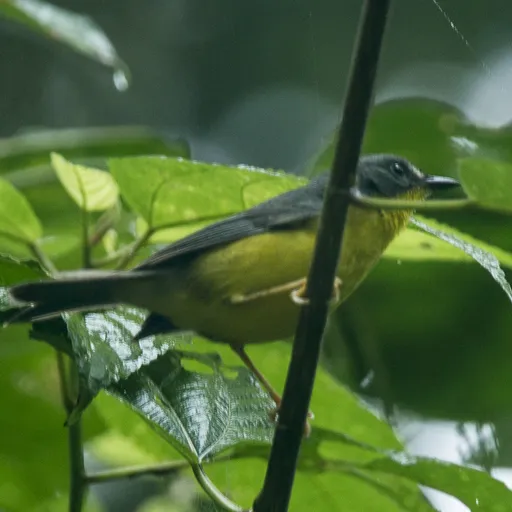
Grey-and-gold Warbler
Myiothlypis fraseri
Least Concern
Listen
XC242878 · Niels Krabbe · Loja: Tambo Negro 10 km E Macará, Ecuador · CC BY-SA 4.0
Overview
The grey-and-gold warbler (Myiothlypis fraseri) is a species of New World warbler in the family Parulidae found in Ecuador and Peru. It is currently assessed as being of Least Concern on the IUCN Red List, though its population is believed to be decreasing.
Identification
- Approximately 14 cm long with blue-gray upperparts and yellow underparts that are lightest on the undertail coverts.
- A lemon-yellow or ochraceous-orange crown stripe bordered in black, contrasting with black lores and a white streak above them on an otherwise blue-gray face.
- Features a black bill, yellow-brown legs and feet, and a brown iris.
- Song begins hesitantly before becoming a short rising series of musical notes described as 'titu, titu, tituyuteeteechee' or 'tu ti tu ti tur-JAEE-JZEEOO'.
Habitat
The species inhabits the understory of diverse landscapes, ranging from drier to humid deciduous forests and scrublands. It is found west of the Andes in Ecuador and northwestern Peru, typically at elevations below 400 m but reaching up to 1,800 m in the southwest.
Diet
Although its diet has not been thoroughly studied, the grey-and-gold warbler is known to feed primarily on invertebrates. It forages mostly in the forest understory and only occasionally joins mixed-species feeding flocks.
Did you know?
The specific epithet 'fraseri' honours Louis Fraser, who collected the first specimen, though the bird was not formally described until 1884.
Sources
- Wikipedia · CC BY-SA 4.0
- Wikidata · CC0 1.0