
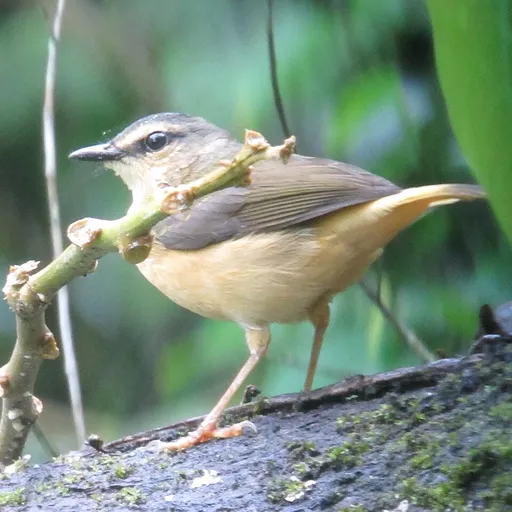
Buff-rumped Warbler
Myiothlypis fulvicauda
Least Concern
Listen
XC242882 · Niels Krabbe · Orellana: 'Maxus' road km 37 (27 km SSE Pompeya), Ecuador · CC BY-SA 4.0
Overview
The buff-rumped warbler (Myiothlypis fulvicauda) is a species of New World warbler in the family Parulidae. It is a sedentary, year-round resident found across a wide range from Honduras to Bolivia.
Identification
- 13.5 cm long and weighs about 15 g, with the same plumage in both sexes.
- Adults of the nominate subspecies feature a slate-gray crown, a buff supercilium, a blackish eye stripe, olive-gray ear coverts, and buffy cheeks.
- The lower rump, uppertail coverts, and the basal half of the tail are tawny-buff, while the remaining tail is dark olive-brown; underparts are whitish with a buff wash on the breast and flanks.
- The song is a short warble running into 8–9 loud ringing 'chew' notes, transcribed as 'sawee-sawee-tee-tee-see-see-TEW-TEW-TEW-TEW-TEW-TEW-TEW-TEW-TEW-TEW-TEW', with calls including an emphatic 'tschick' or a hollow 'peak!'.
Habitat
Found from Honduras south to Bolivia, this species inhabits forest landscapes along large and small watercourses in the foothills and swamps in the lowlands. Its elevation range varies by region, from sea level up to approximately 1,700 m in Colombia and 1,500 m on the Pacific slope of Costa Rica.
Diet
Feeds primarily on insects and other invertebrates, foraging by hopping along the forest floor and fallen logs while continuously pumping and wagging its tail. It mostly gleans prey but occasionally takes it in mid-air with a sally from the ground, foraging around wet areas, temporary puddles, and along watercourses; in Costa Rica, it often attends swarms of army ants.
Did you know?
Pairs defend a linear territory along a watercourse year-round and build bulky domed nests with a side entrance, typically placed on a sloping earthen bank by a stream or path.
Sources
- Wikipedia · CC BY-SA 4.0
- Wikidata · CC0 1.0