
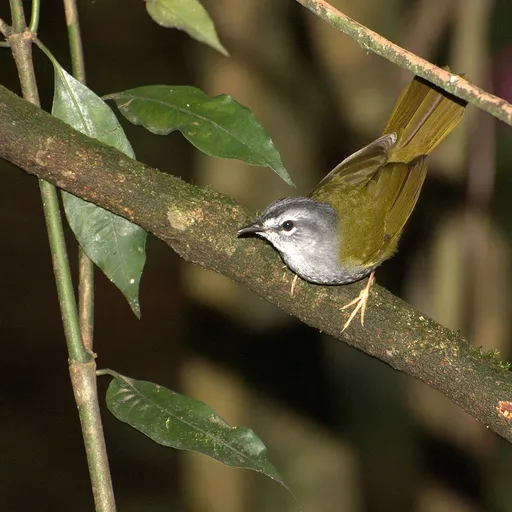
White-rimmed Warbler
Myiothlypis leucoblephara
Least Concern
Overview
The white-rimmed warbler, also known as the white-browed warbler (Myiothlypis leucoblephara), is a species of New World warbler found across parts of South America. It is currently assessed as being of Least Concern on the IUCN Red List, although its population is believed to be decreasing.
Identification
- Approximately 14.5 cm in length with olive-green upperparts and underparts that are mostly whitish or medium gray depending on the subspecies.
- Distinctive facial markings include a blackish gray crown stripe, white stripe above the lores, a thin black line through the eye, and white crescents above and below the eye.
- Possesses a blackish bill and orange-pink legs and feet.
- The song is described as a fairly long series of 'fee' notes that start at an extra-high level and descend steeply, accompanied by a sharp, penetrating 'pseeyk' call.
Habitat
Primarily inhabits gallery forest and mature secondary forest with dense understories, often occurring near water though less dependent on it than some related species. Its range covers southern Brazil, eastern Paraguay, northeastern Argentina, and Uruguay, extending from sea level up to 1,600 m in elevation.
Diet
The diet is assumed to consist entirely or nearly entirely of invertebrates with very small amounts of plant material. The bird takes prey by gleaning on or near the ground, foraging mostly in dense undergrowth but occasionally in the open, and seldom joins mixed-species feeding flocks.
Did you know?
Despite being a sedentary year-round resident that maintains its territory, the species' breeding season has not been defined and almost nothing is known about its breeding biology other than the structure of its dome-shaped nests with side entrances.
Sources
- Wikipedia · CC BY-SA 4.0
- Wikidata · CC0 1.0