
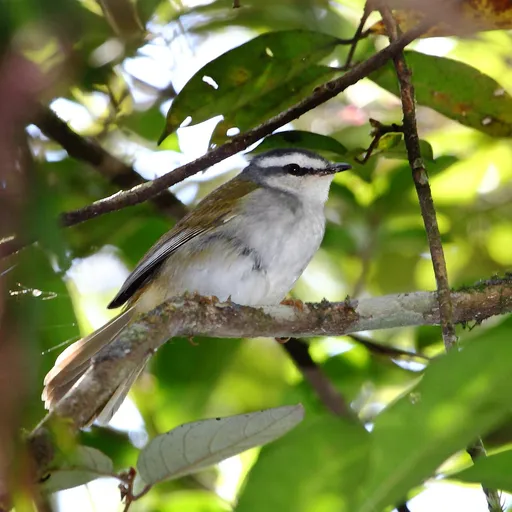
White-striped Warbler
Myiothlypis leucophrys
Least Concern
Overview
The white-striped warbler (Myiothlypis leucophrys) is a New World warbler endemic to Brazil. It is currently assessed as Least Concern on the IUCN Red List, although its population is believed to be decreasing due to the rapid clearing of its riparian habitat.
Identification
- 14 cm long and weighing 15 to 22 g, with identical plumage in both sexes.
- Features a grey central crown bordered by thin blackish stripes, a long white supercilium, and a blackish stripe through the eye.
- Upperparts are brownish olive; underparts are mostly white with grey breast sides and yellowish buff undertail coverts.
- Possesses a dark iris, a blackish bill, and yellowish pink legs and feet.
- Song consists of a series of pure, fluted notes, including double notes or short trills, while calls are described as extremely high tinkling.
Habitat
Found in south-central Brazil within a rough triangle formed by southern Mato Grosso, central Goiás, southern Tocantins, and southern Minas Gerais to northern São Paulo state. It almost exclusively inhabits riparian forest with dense undergrowth, ranging in elevation from near sea level to 1,000 m. The species is a sedentary, year-round resident.
Diet
The specific diet has not been studied but is believed to be entirely or almost entirely invertebrates. Foraging involves walking or hopping on or near the ground to take most prey, and the bird seldom joins mixed-species feeding flocks.
Did you know?
The shiny cowbird (Molothrus bonariensis) is an occasional brood parasite of this species. Its breeding nest is a globe constructed from thin roots and twigs with leaves on the sides and bottom, featuring a side entrance.
Sources
- Wikipedia · CC BY-SA 4.0
- Wikidata · CC0 1.0