
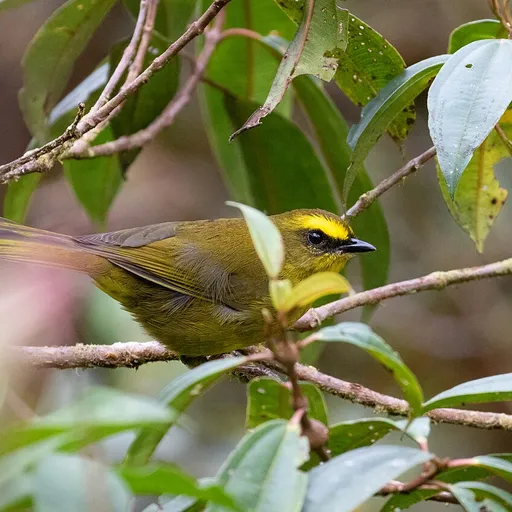
Citrine Warbler
Myiothlypis luteoviridis
Least Concern
Listen
XC242889 · Niels Krabbe · Loja: Cerro Acanamá, Ecuador · CC BY-SA 4.0
Overview
The Myiothlypis luteoviridis is a species of bird in the family Parulidae, commonly known as the New World warblers. Its English name derives from the Latin word citrus, meaning yellow.
Identification
- Adults of the nominate subspecies feature an olive-green crown, a short yellow supercilium, and a short blackish line through the eye, with a faint yellowish to whitish crescent below the eye.
- Underparts are mostly yellow, often with an olive wash on the sides of the breast and flanks, while the nape and upperparts are olive-green.
- The bill is black and the iris is dark brown, grey, or black, though the legs and feet are of highly variable color.
- Song varies by subspecies, ranging from short, fast, chattery trills ending in distinct notes to long series of rich, jerky, ringing warbles that build in volume.
Habitat
Found across Bolivia, Colombia, Ecuador, Peru, and Venezuela, the species has a disjunct distribution where most subspecies' ranges do not adjoin. It inhabits a variety of forested landscapes, including the interior and shrubby borders of humid montane forest, cloud forest, elfin forest, and scrub at tree line. Elevation varies by country, generally ranging from 2,100 m to 3,700 m.
Diet
The diet is believed to be entirely or almost entirely invertebrates, though it has not been formally studied. Prey is taken by gleaning in the forest's lower to middle levels. During the breeding season, it forages in pairs or small groups, while in the non-breeding season it often joins mixed-species feeding flocks.
Did you know?
Breeding seasons vary geographically but have not been fully defined, with evidence of breeding occurring in August through October in Colombia, September to November in Peru, and January in Bolivia. Additionally, the nest has not been fully described, though one photographed nest was a cup containing two white eggs with dark markings.
Sources
- Wikipedia · CC BY-SA 4.0
- Wikidata · CC0 1.0