
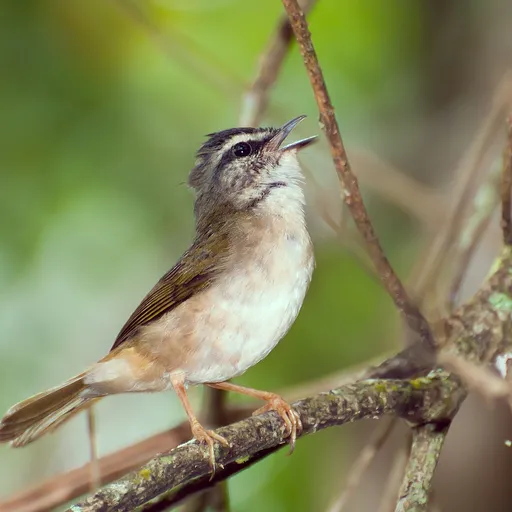
Riverbank Warbler
Myiothlypis rivularis
Least Concern
Listen
XC433995 · maria belotti · Cananéia, São Paulo, Brazil · CC BY-SA 4.0
Overview
The riverbank warbler (Myiothlypis rivularis) is a species of New World warbler in the family Parulidae. It is a sedentary bird found across South America, ranging from the Guianas and northern Brazil down to southeastern Brazil, Paraguay, and Argentina.
Identification
- Length of 11 to 14 cm with sexes possessing the same plumage.
- Nominate subspecies feature a slate gray crown, whitish supercilium separated by a thin black line, and olive-brown ear coverts with buff streaks.
- Upperparts, wings, and tail are dark olive, while the underparts are mostly whitish with a buff wash on the breast, flanks, and belly.
- Song consists of a high-descending series of feew notes that transform into forceful, level, rattled tjehtjeh sounds; calls include tek, trrek, and tseeu.
Habitat
The species inhabits rainforests along large and small watercourses, as well as swamps, typically relying on intact forest environments. Its range is disjunct, covering eastern Venezuela, the Guianas, and northern Brazil, as well as southeastern Brazil, eastern Paraguay, and parts of Bolivia and Argentina. It occurs from sea level up to elevations of 1,100 m in Venezuela and as high as 1,400 m in Bolivia.
Diet
This bird feeds primarily on insects and other arthropods, often gleaned from the ground or captured in mid-air via sallies. Pairs hop along the forest floor, fallen logs, and forest paths near watercourses, and occasionally attend swarms of army ants.
Did you know?
The riverbank warbler has a complicated taxonomic history involving multiple genus reassignments and remains subject to debate regarding its species boundaries. Some authorities split it into two distinct species, the 'northern' and 'southern' riverbank warblers, while others maintain it as a single species with three subspecies.
Sources
- Wikipedia · CC BY-SA 4.0
- Wikidata · CC0 1.0