
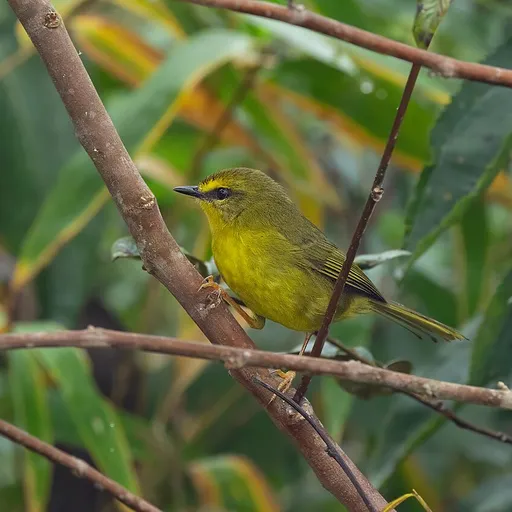
Pale-legged Warbler
Myiothlypis signata
Least Concern
Overview
The pale-legged warbler (Myiothlypis signata) is a species of New World warbler found in Argentina, Bolivia, and Peru. The IUCN has assessed the species as being of Least Concern, and it is considered fairly common in most of its Peruvian range.
Identification
- Length is 13.5 cm with a weight of 12.1 to 13.4 g.
- Adults feature an olive-green head with a blackish stripe through the eye, a yellow crescent under the eye, and a yellow throat; underparts are yellow with a faint olive wash on the breast and flanks.
- The song is described as an accelerating series of ringing notes that rise and fall, ending in a rapid flourish, while the call is a low "djitit" that may extend into a chatter.
- Possesses a dark iris, a blackish bill, and yellowish pink legs and feet.
Habitat
The species inhabits the interior and edges of humid montane forest, favouring dense undergrowth along small watercourses and stands of Chusquea bamboo. Its elevational range generally lies between 1,500 m and 3,050 m, though specific measurements vary by location.
Diet
The diet is assumed to consist mostly or entirely of invertebrates, though it has not been formally studied. The bird forages mostly in pairs or family groups within 2 m of the ground, gleaning prey from dense low undergrowth and sometimes taking it on the wing.
Did you know?
The pale-legged warbler was formally described in 1906 under the binomial Basileuterus signatus, before being reassigned to the genus Myiothlypis by major taxonomic authorities between 2012 and 2016.
Sources
- Wikipedia · CC BY-SA 4.0
- Wikidata · CC0 1.0